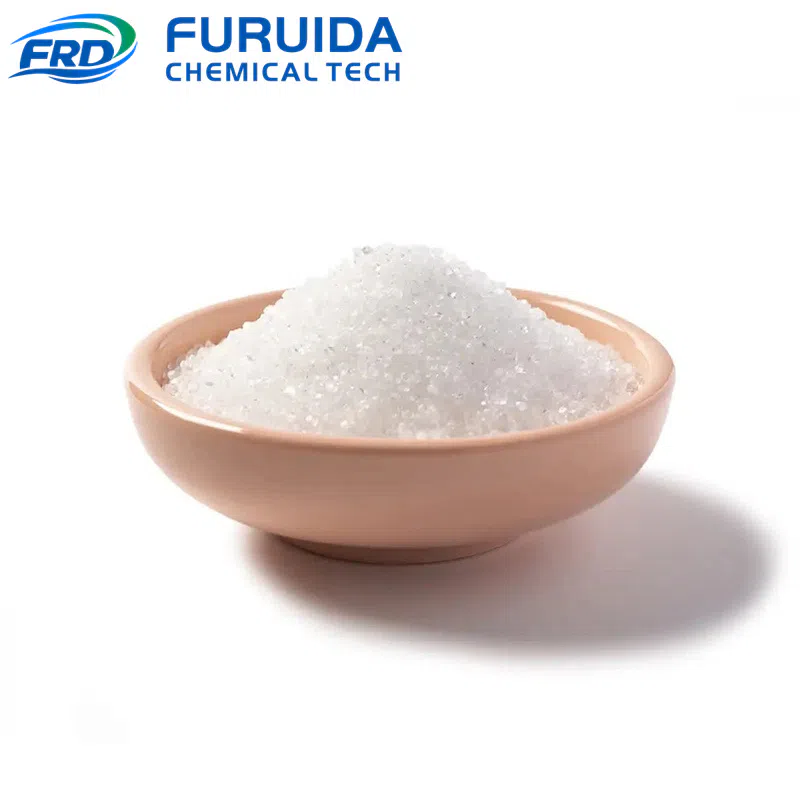
Citric Acid CAS#77-92-9
Citric acid is a white, crystalline, weakly acidic organic compound that occurs naturally in most plants and many animals, serving as an intermediate in cellular respiration. Because it possesses three carboxyl groups, it is classified as a carboxylic acid, specifically, a tricarboxylic acid. The word "citrus" derives from the Greek kedromelon, meaning "apple of melon", a term referring to the citron fruit. Ancient Greek texts use terms such as kitron, kitrion, or kitreos to describe the citron, an oval fruit, several inches in length, produced by the shrub-like tree Citrus medica. Lemons and limes are particularly rich in citric acid, which can account for up to 8% of their dry weight.
Citric acid is a weak acid; when dissolved in solution, its three carboxyl groups (COOH) release hydrogen ions. Once each group has lost a hydrogen ion, the citrate ion (C₃H₅O(COO)₃³⁻) is formed. Intermediate ions may also be generated during partial ionization. Citrate ions readily bind with metal ions to form salts, the most common example being calcium citrate. Additionally, citric acid can react to form esters, yielding various citrate compounds such as trimethyl citrate and triethyl citrate.
Citric acid is widely used as an acidulant and antioxidant; it is typically produced through the mold fermentation of sugar solutions but can also be extracted from lemon juice, lime juice, and pineapple processing residues. It is the primary acid found in oranges, lemons, and limes and exists in two forms: anhydrous form and monohydrate form. The anhydrous form crystallizes from hot solutions, whereas the monohydrate form crystallizes from cooler solutions at temperatures below 36.5°C. At 20°C, the solubility of anhydrous citric acid is approximately 146 g per 100 mL of distilled water, while that of citric acid monohydrate is approximately 175 g. A 1% aqueous solution has a pH of approximately 2.3 at 25°C.
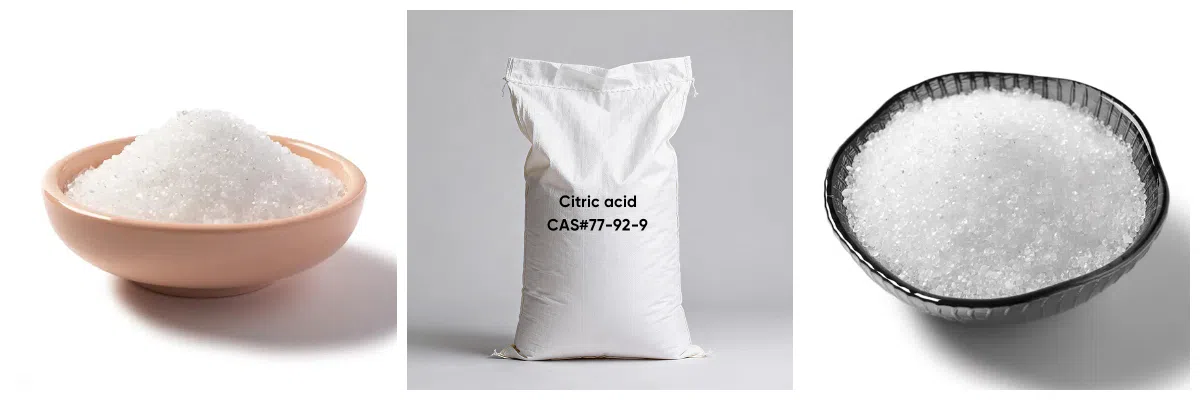
Chemical Properties
| Melting point | 153-159 °C (lit.) |
| Boiling point | 248.08°C (rough estimate) |
| density | 1.67 g/cm3 at 20 °C |
| vapor density | 7.26 (vs air) |
| vapor pressure | <0.1 hPa (20 °C) |
| refractive index | 1.493~1.509 |
| FEMA | 2306 | CITRIC ACID |
| Fp | 100 °C |
| storage temp. | 2-8°C |
| solubility | Citric acid also dissolves in absolute (anhydrous) ethanol (76 parts of citric acid per 100 parts of ethanol) at 15 °C. |
| form | grit |
| pka | 3.14(at 20℃) |
| color | White |
| PH | 3.24(1 mM solution);2.62(10 mM solution);2.08(100 mM solution); |
| Odor | Odorless |
| Odor Type | odorless |
| explosive limit | 8%, 65°F |
| Water Solubility | soluble in Water (1174g/L at 10°C, 1809g/L at 30°C, 3825g/L at 80°C). |
| Sensitive | Hygroscopic |
| λmax | λ: 260 nm Amax: 0.20 λ: 280 nm Amax: 0.10 |
| Merck | 14,2326 |
| JECFA Number | 218 |
| BRN | 782061 |
| Stability: | Stable. Incompatible with bases, strong oxidizing agents, reducing agents, metal nitrates. |
| InChIKey | KRKNYBCHXYNGOX-UHFFFAOYSA-N |
| LogP | -1.64 |
| CAS DataBase Reference | 77-92-9(CAS DataBase Reference) |
| NIST Chemistry Reference | 1,2,3-Propanetricarboxylic acid, 2-hydroxy-(77-92-9) |
| EPA Substance Registry System | Citric acid (77-92-9) |
Safety Information
| Hazard Codes | Xi,C,T |
| Risk Statements | 41-36/37/38-36/38-37/38-34-36-35-61-60 |
| Safety Statements | 26-39-37/39-24/25-36/37/39-45-36-53 |
| RIDADR | UN 1789 8/PG 3 |
| WGK Germany | 1 |
| RTECS | GE7350000 |
| F | 9 |
| TSCA | Yes |
| HS Code | 2918 14 00 |
| Hazardous Substances Data | 77-92-9(Hazardous Substances Data) |
| Toxicity | LD50 in mice, rats (mmol/kg): 5.0, 4.6 i.p. (Gruber, Halbeisen) |
Product Applications
Citric acid is hygroscopic and has a sharp, acidic taste, making it widely used in the food industry. Typical applications include fruit drinks and carbonated beverages (at levels of 0.25% to 0.40%), cheese (3% to 4%), and jellies. It also serves as an antioxidant in products such as instant potatoes, wheat chips, and potato sticks, helping to prevent spoilage by chelating metal ions. Additionally, when used in conjunction with other antioxidants, it helps inhibit discoloration in fresh frozen fruits.
Factory and Equipment Show