
Dual Drivers of New Energy Metal Smelting and Phosphate Fertilizer Demand Reshape the Supply Landscape
1. Global Supply-Demand Dynamics: Surging Smelting Demand and Structurally Tight Raw Material Supply
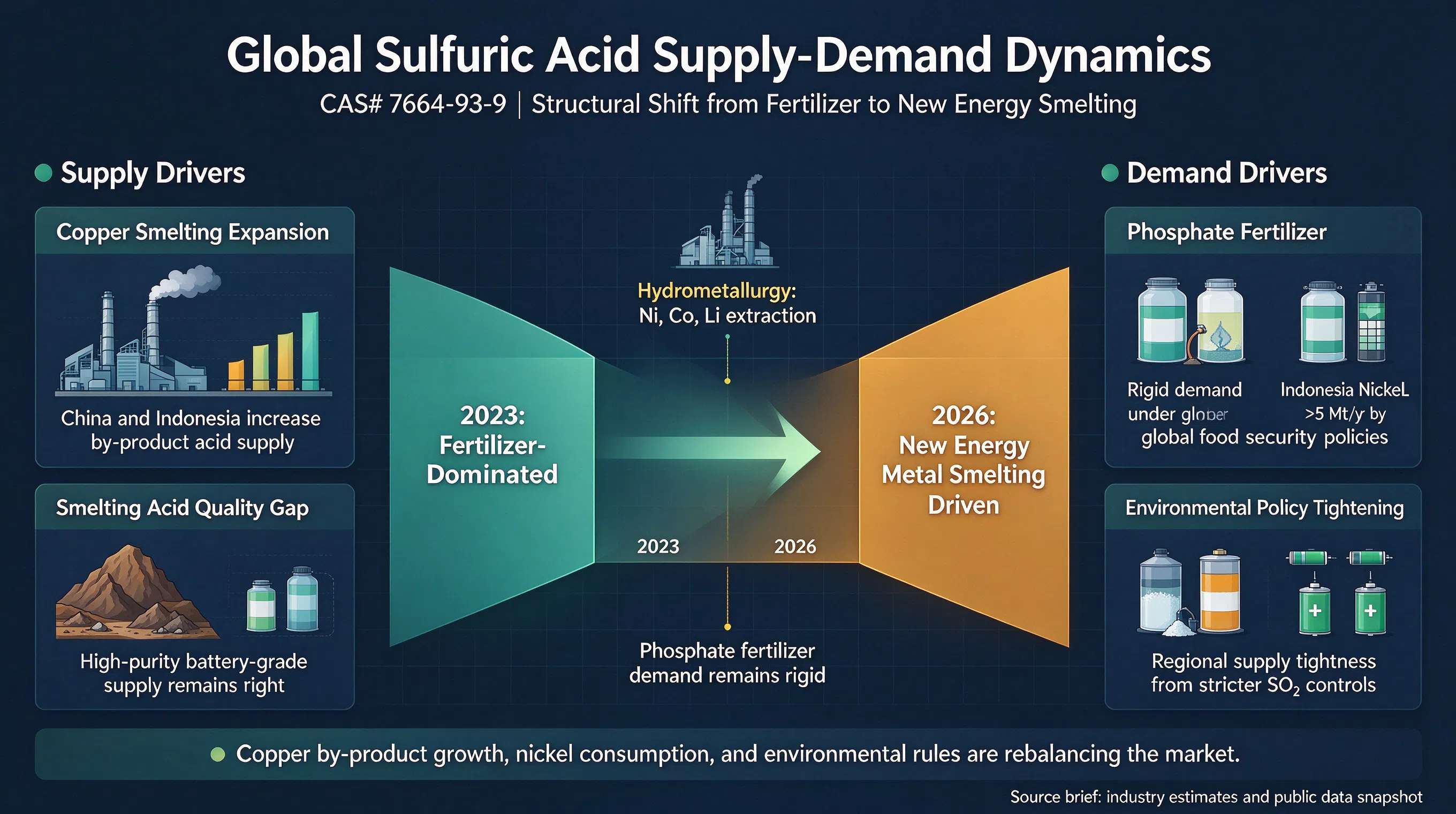
From 2023 to 2026, the global sulfuric acid market is undergoing a structural shift from being "dominated by traditional fertilizers" to being "driven by new energy metal smelting." As a key raw material for hydrometallurgy (especially nickel, cobalt, and lithium extraction) and phosphate fertilizer production, its supply chain is deeply influenced by the expansion of copper smelting capacity and environmental policies.
Copper Smelting Capacity Expansion Drives By-Product Acid Supply: The continuous expansion of global copper smelting capacity (especially in China and Indonesia) has significantly increased the supply of smelting by-product sulfuric acid. However, due to inconsistent quality of by-product acid (some containing impurities such as arsenic and fluorine), there remains a supply gap for high-purity sulfuric acid that meets new energy battery-grade requirements.
Resonance of Phosphate Fertilizer and New Energy Demand: Influenced by global food security policies, the demand for acid used in phosphate fertilizers remains rigid. Meanwhile, as Indonesia is a global hub for nickel resource processing, its HPAL (High Pressure Acid Leaching) projects have extremely high sulfuric acid consumption per unit. It is estimated that by 2026, sulfuric acid demand in Indonesia's nickel smelting sector will exceed 5 million tons per year (industry estimate).
Tightening Environmental Policies: China and the EU have increasingly stringent sulfur dioxide emission standards for sulfuric acid production, leading to the shutdown or production restriction of some small and medium-sized sulfuric acid plants, resulting in阶段性 (periodic) regional supply tightness.
Sulfuric Acid CAS# 7664-93-9
2. Production Landscape: China's Capacity Dominance and Rising Share of Smelting Acid
China remains the world's largest producer and consumer of sulfuric acid, accounting for approximately over 40% of global capacity. With the expansion of domestic non-ferrous metal smelting capacity, the proportion of smelting off-gas acid in total output has exceeded 35%, gradually replacing traditional sulfur-burning acid as the mainstream supply source.
Capacity Consolidation and Regional Transfer: From 2024 to 2025, some outdated sulfur-burning acid facilities in North and East China exited due to environmental pressure, while Southwest and Northwest China, relying on local phosphate rock and smelting resources, built several large-scale smelting acid plants.
Green and Low-Carbon Technology Breakthroughs: Leading enterprises such as Jiangxi Copper and Tongling Nonferrous are promoting low-temperature waste heat recovery and high-concentration sulfur dioxide conversion technologies, which not only reduce energy consumption but also significantly cut tail gas emissions. Some companies have achieved a "zero wastewater discharge" closed loop in smelting acid production.
Sulfuric Acid CAS# 7664-93-9
3. Application Innovation: Extending to High-Purity Electronic and Battery Grades
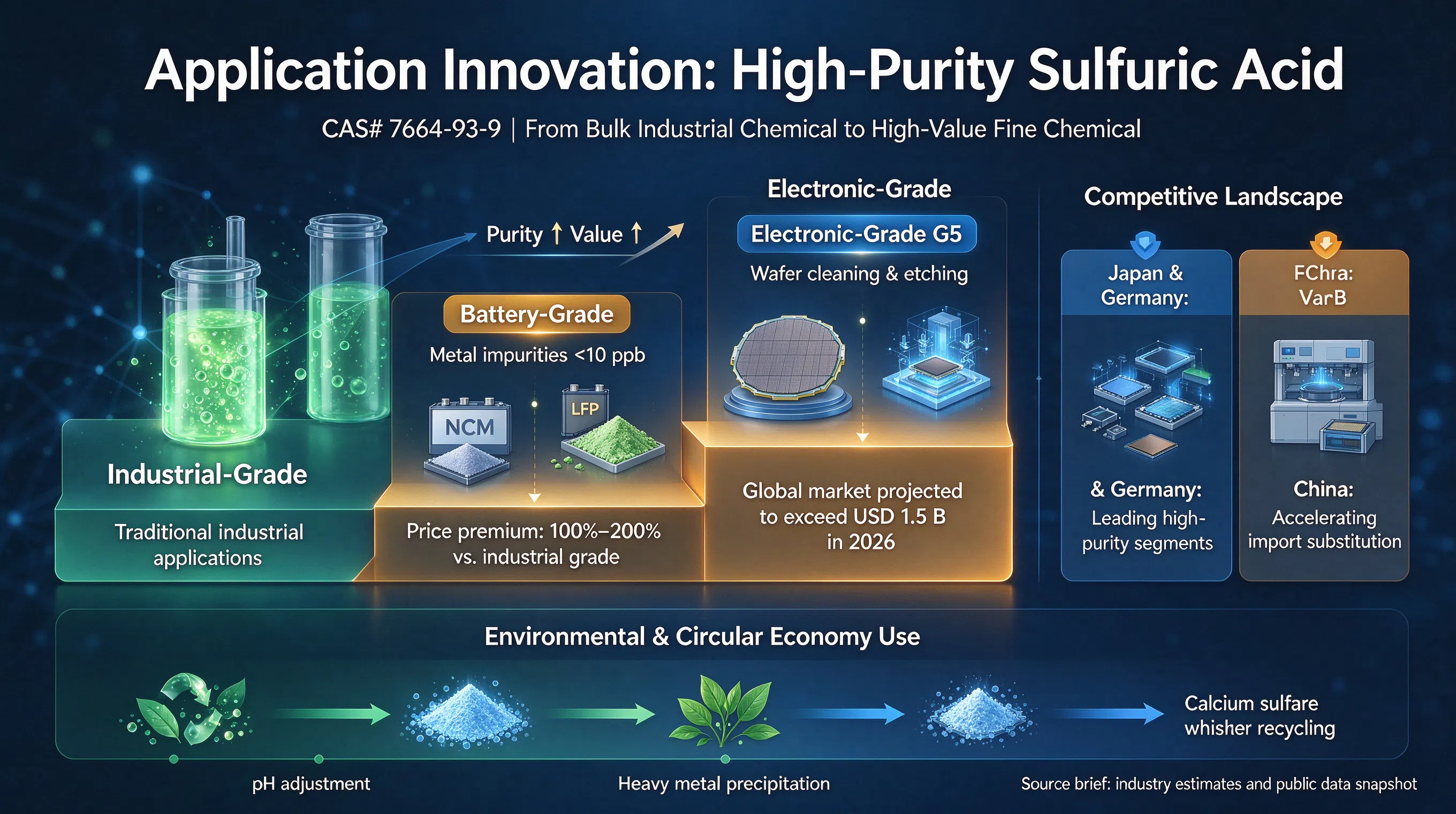
Benefiting from the explosion of the new energy and semiconductor industries, sulfuric acid is extending from a bulk industrial product to high-value-added fine chemicals.
Battery-Grade Sulfuric Acid (High Purity): As ternary precursors (NCM) and lithium iron phosphate (LFP) batteries have increasingly stringent requirements for impurity content, demand for battery-grade sulfuric acid (metal impurities <10 ppb) has surged. The price of this grade is 100%-200% higher than industrial-grade sulfuric acid.
Electronic-Grade Sulfuric Acid (G5 Grade): In semiconductor wafer cleaning and etching processes, electronic-grade sulfuric acid is an indispensable key material. With the global expansion of wafer fabs, the global electronic-grade sulfuric acid market is projected to exceed USD 1.5 billion in 2026 (Grand View Research data). Japanese companies such as Mitsubishi Chemical and German company BASF dominate this field, while Chinese companies are accelerating import substitution.
Wastewater Treatment and Recycling: In the environmental protection field, sulfuric acid is widely used for pH adjustment and heavy metal precipitation. New resource utilization technologies for by-products such as calcium sulfate whiskers are becoming new growth points for the industry's circular economy.
Sulfuric Acid CAS# 7664-93-9


