
Asiaticoside CAS 16830-15-2: Uses and Skin Benefits
What Is Asiaticoside?
Asiaticoside is a triterpenoid saponin associated with Centella asiatica, also known as Gotu Kola. The plant has a long history of use in Asian traditional medicine and has also been studied for cosmetic applications. Reviews of Centella asiatica identify asiaticoside, madecassoside, asiatic acid, and madecassic acid as important triterpenoid compounds in the plant.
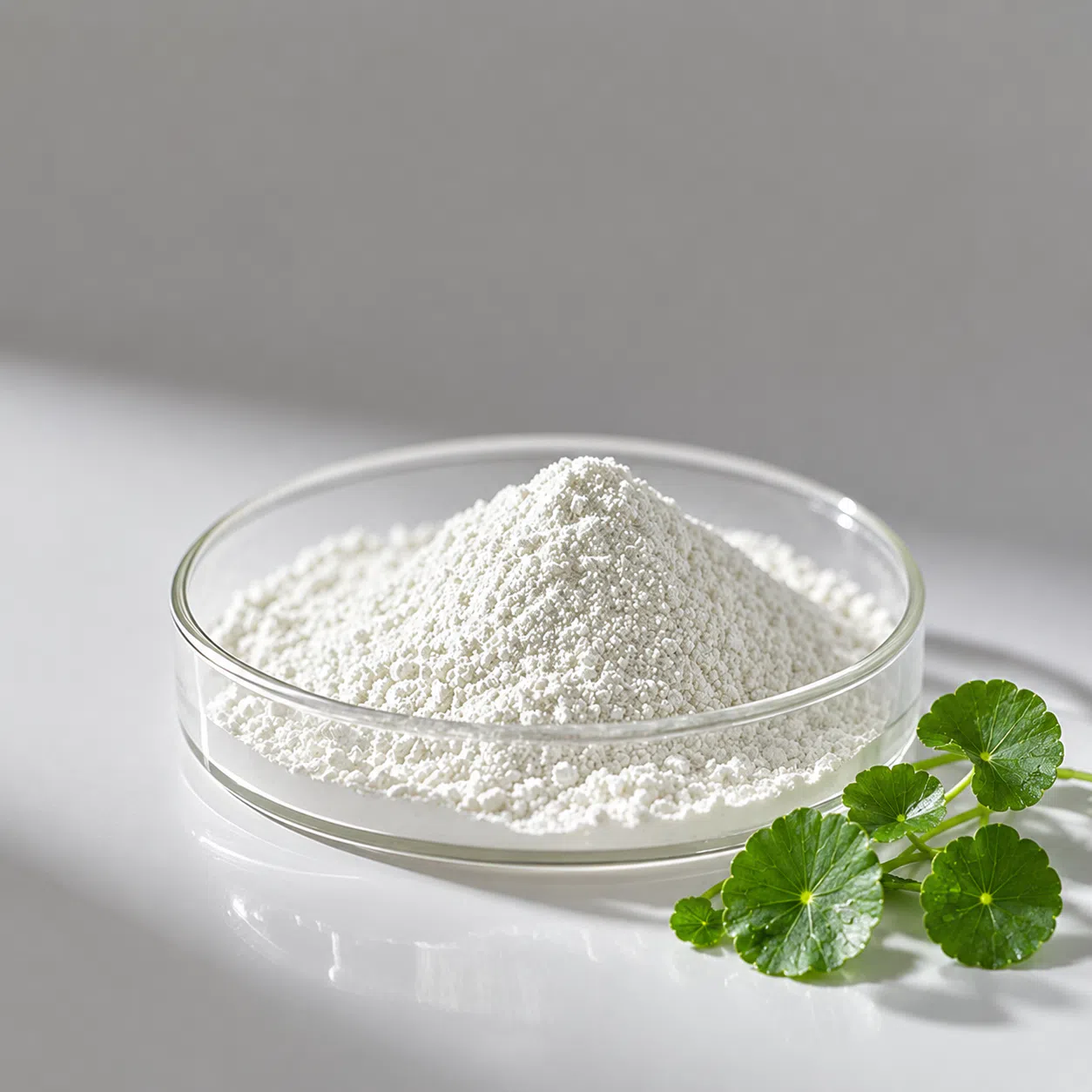
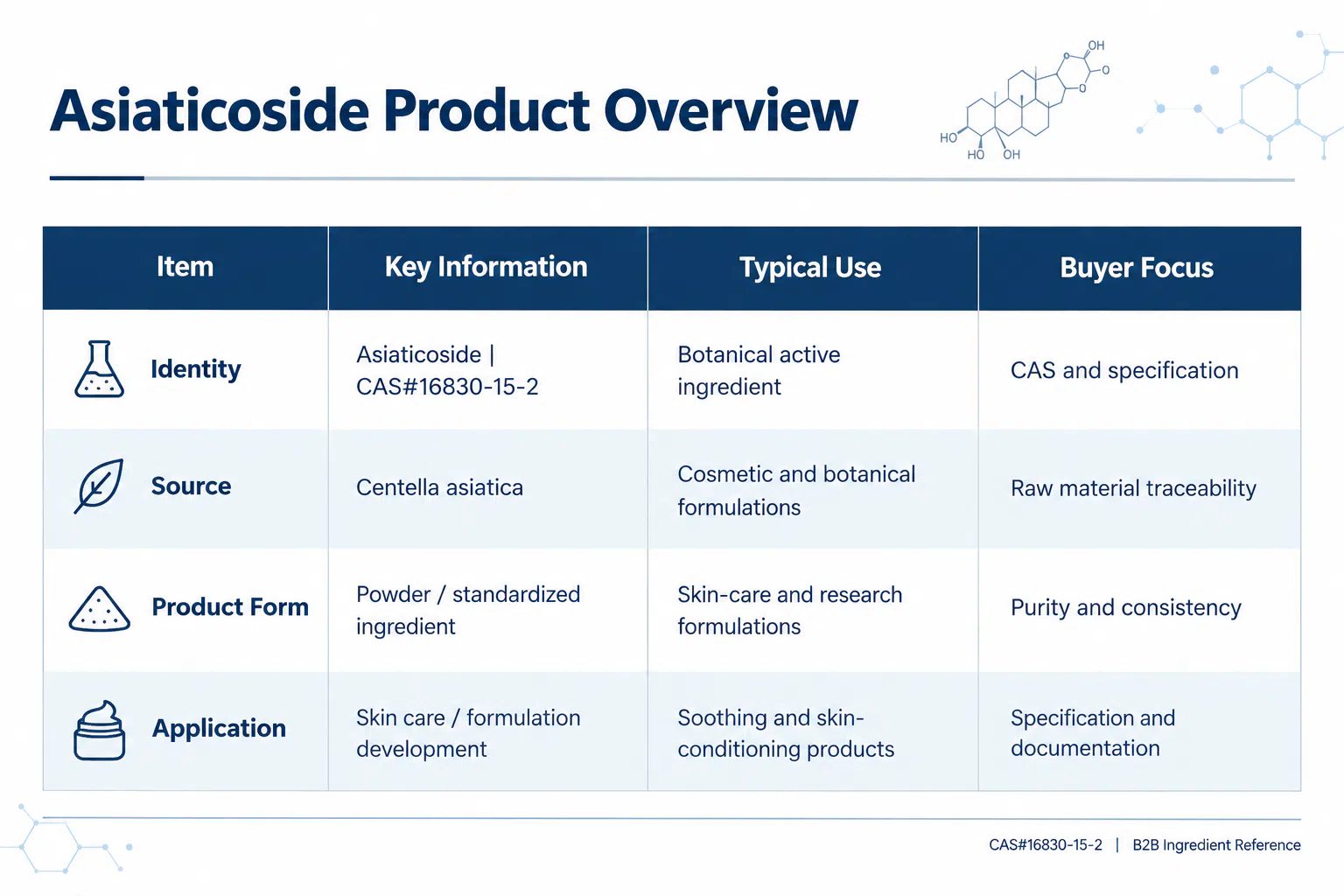
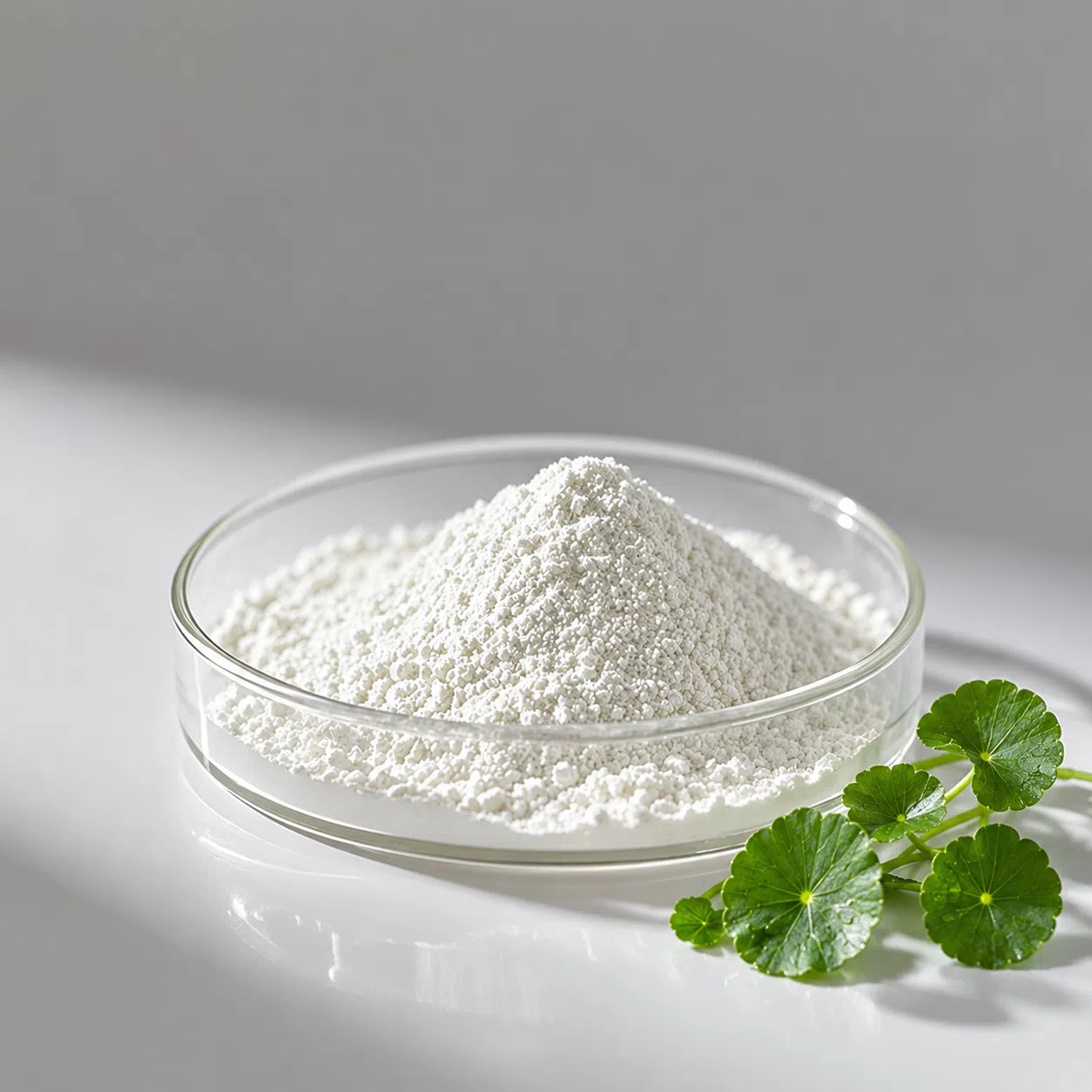
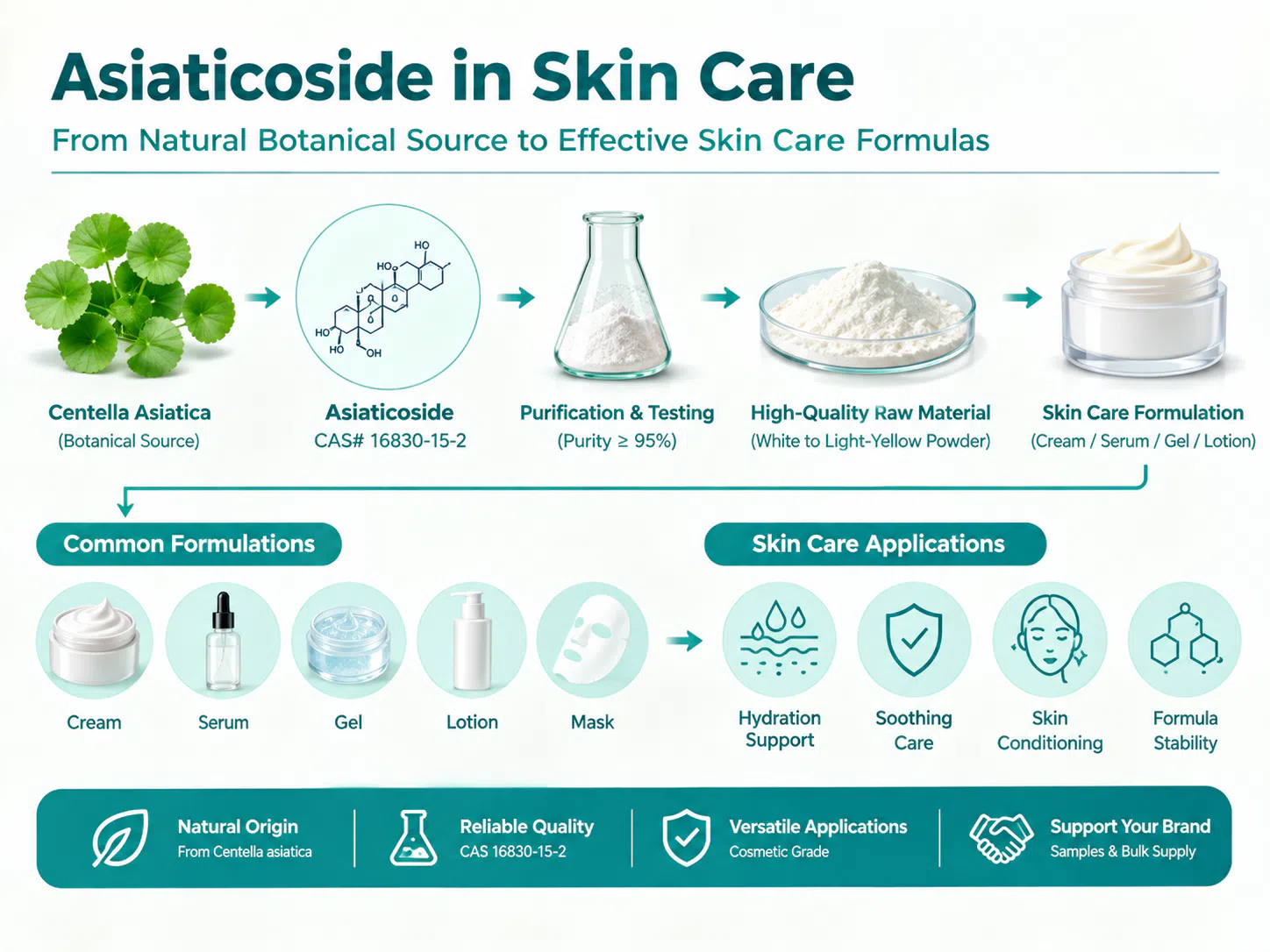
For B2B buyers, the chemical identity is important when comparing suppliers. The CAS number of asiaticoside is 16830-15-2. Its molecular formula is C48H78O19, and its molecular weight is about 959.13 g/mol. Commercial analytical references list it as a solid material that is commonly supplied as a white to light-yellow powder or crystalline material.
The available specifications can differ between suppliers. For example, one analytical supplier lists a purity of more than 95% by HPLC and qNMR, while another datasheet lists a purity specification of at least 98%. This shows why buyers should review the supplier's current specification and test method rather than comparing only the product name.
Asiaticoside and Centella Asiatica
The relationship between asiaticoside and Centella asiatica is important for ingredient sourcing.
Centella asiatica is a botanical source. Asiaticoside is one of the triterpenoid compounds associated with this plant. Other compounds from the same botanical source include madecassoside, asiatic acid, and madecassic acid. Their chemical structures are different, so buyers should not treat all Centella-derived ingredients as interchangeable.
This distinction is especially useful when developing a new cosmetic formula. A product specification should clearly state the ingredient name, CAS number, purity, analytical method, and required quality parameters.
What Is Asiaticoside Used For?
The main commercial interest is related to cosmetic and skin-care research. Supplier information lists cosmetic research among its intended uses, while cosmetic ingredient references describe asiaticoside as an ingredient used for skin-conditioning applications.
The use of the ingredient should also be considered in the context of the final formula. An active raw material does not work independently. Its performance can depend on concentration, dispersion, pH, solvent system, emulsifier selection, packaging, and storage conditions.
For this reason, B2B buyers normally need more than a product name. A technical data sheet and certificate of analysis can provide more useful information during product development.
Application in Skin Care
The growing interest in botanical ingredients is closely connected with changes in the beauty market. McKinsey reports that consumers are becoming more focused on product quality and perceived value. In skin care, products with clear performance differentiation can attract more attention than products supported only by marketing claims.
This creates a practical role for well-characterized cosmetic ingredients. Buyers can use ingredient specifications to evaluate whether a raw material fits their formulation and quality requirements.
Research reviews have discussed asiaticoside and other Centella-derived compounds in relation to skin-related applications. However, research findings should not automatically be treated as guaranteed results for every commercial cosmetic formula. The final product must be assessed according to its complete composition and intended use.
Asiaticoside Skin Benefits
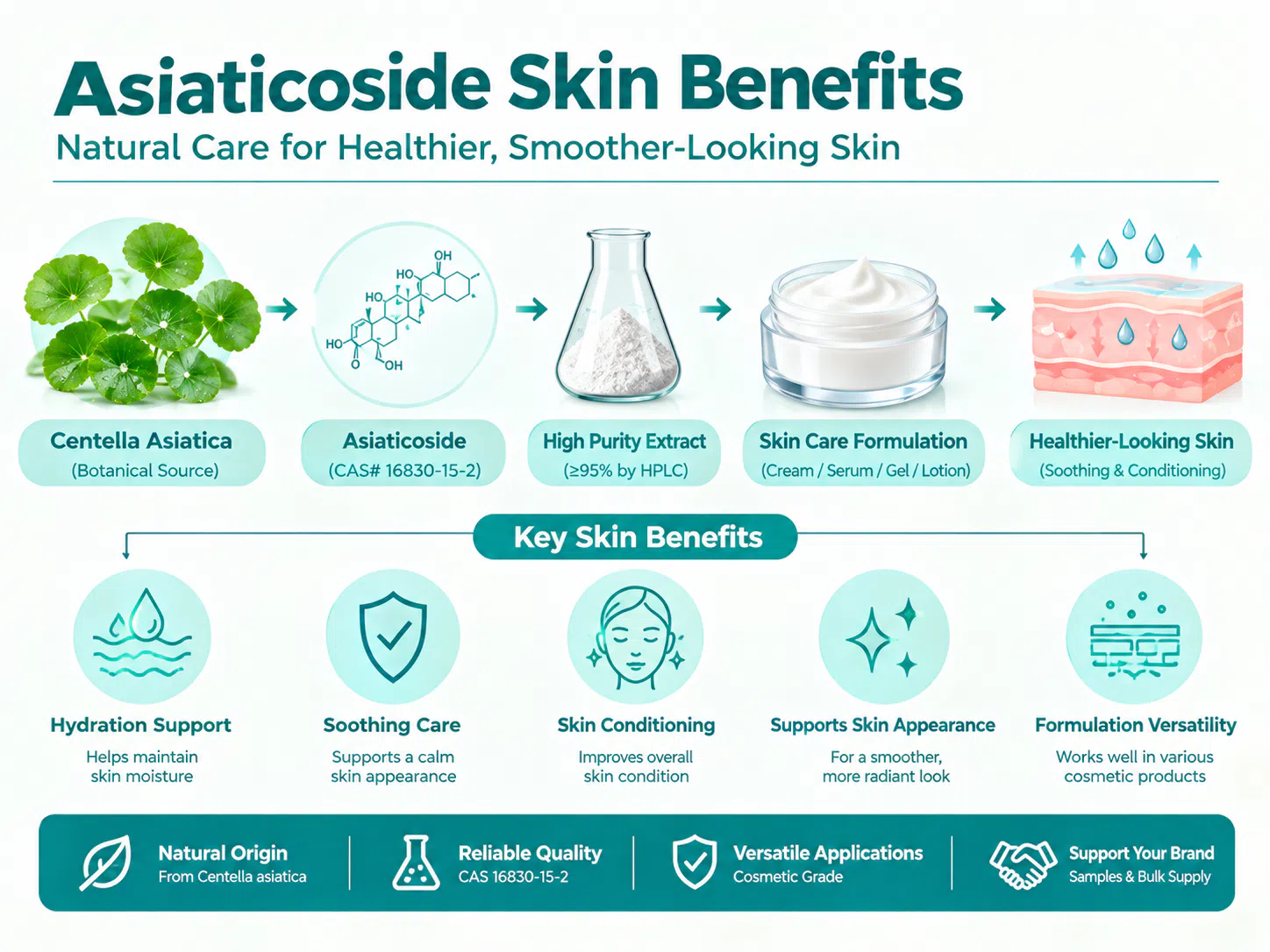
The phrase Asiaticoside Skin Benefits is commonly associated with discussions about soothing, conditioning, skin appearance, and formulation support. Scientific literature has investigated the biological activity of asiaticoside and other Centella compounds, while cosmetic ingredient references identify skin-conditioning as an important application area.
Skin-Conditioning Applications
Skin conditioning is a broad cosmetic concept. It does not mean that one ingredient can solve every skin problem. Instead, it describes the use of an ingredient to support the desired feel, appearance, or condition of the skin in a finished product.
This makes the ingredient relevant to formulas designed around soothing and skin-care concepts.
Support for Modern Skin Care Formulas
Modern consumers often want products that are easy to understand. Botanical ingredients can provide a clear story when their identity, source, and technical characteristics are properly documented.
A recent cosmetic safety assessment reviewed several Centella asiatica-derived ingredients and reported that they primarily function as skin-conditioning agents in cosmetics. The assessment also emphasized formulation to be non-sensitizing under the conditions considered.
This is useful information for formulators because safety cannot be judged from the raw material name alone. The final concentration and complete formula also matter.
Research Versus Commercial Claims
There is a large amount of research on Centella-derived compounds. Some reviews discuss collagen-related activity, wound-healing research, skin hydration, photoaging, and other biological effects.
For international cosmetic businesses, it is better to separate research findings from finished-product claims. A responsible product description should explain what the ingredient is and how it is used rather than promise a medical result.
This approach can also make technical communication easier when a raw material is sold to different markets.
Asiaticoside in Skin Care Formulations
Asiaticoside in Skin Care can cover several types of cosmetic formulation. The final choice depends on the formula design and the manufacturer's technical process.
Possible product formats include:
1.Creams
2.Gels
3.Serums
4.Lotions
5.Masks
6.Skin-conditioning products
The ingredient's physical properties should be considered before selecting a formulation system. TCI lists asiaticoside as a solid and reports limited water solubility, with a reference solubility of 99 mg/L at 20°C. The same source identifies heat as a condition to avoid and lists frozen storage for its analytical product.
This means formulators should not simply add the powder directly into a water-based formula without checking the required processing conditions.
Asiaticoside Cream
Asiaticoside Cream is one possible application because creams can combine oil and water phases and can be designed for controlled delivery of cosmetic ingredients.
During development, a formulator may first evaluate the raw material's solubility and dispersion behavior. The ingredient can then be incorporated into a suitable phase or pre-dispersion system based on the formulation design.
The exact process depends on the complete formula. Temperature, mixing speed, order of addition, pH, and preservation system may all influence the final product.
For this reason, buyers should request formulation guidance or technical documentation from the raw material supplier when developing a new product.
Technical Considerations for International Buyers
A professional purchasing process should begin with technical documentation.
Purity and Analytical Method
Purity is one of the first specifications buyers normally compare. However, the number itself is not enough.
Different analytical methods can produce different types of information. Commercial suppliers may use HPLC, qNMR, or other analytical techniques. TCI, for example, lists a minimum 95% purity specification by HPLC and qNMR for its analytical product.
A buyer should therefore ask:
1.What is the assay specification?
2.Which analytical method is used?
3.Is a COA provided for every batch?
4.Is the result based on HPLC, qNMR, or another method?
5.What are the limits for moisture and impurities?
Appearance and Physical Properties
Physical appearance can also help with incoming quality inspection.
Commercial reference products describe asiaticoside as a white to light-yellow powder or crystal. Melting-point values around 231–238°C have been reported by commercial analytical sources.
However, buyers should use the supplier's own current specification as the acceptance standard for a commercial shipment.
Storage and Packaging
Storage requirements should be discussed before an international order is placed.
Heat sensitivity and limited water solubility can affect how the raw material is handled. TCI currently recommends frozen storage for its analytical product and lists heat as a condition to avoid.
Commercial buyers should also confirm:
1.Package size
2.Inner and outer packaging
3.Storage temperature
4.Shelf life
5.Batch number
6.Manufacturing date
7.Certificate of analysis
8.Transportation conditions
Manufacturing and Quality Control
The production route can vary depending on the supplier and target specification. In commercial sourcing, buyers are usually more concerned with consistent quality and traceability than with a single production method.
A typical quality-control process may include raw material identification, extraction or preparation, purification, concentration, drying, testing, and final packaging. The exact process should be confirmed with the manufacturer because not every supplier uses the same production technology.
The final material should be tested against an agreed specification.
For B2B procurement, a practical quality document package can include a COA, specification sheet, SDS, test method information, batch number, and storage recommendation.
Some commercial suppliers also provide certificates and analytical documents with their products. TCI, for example, lists SDS, specifications, certificates, and analytical charts among its available product documents.
Market Trends and B2B Opportunities
The beauty market is becoming more selective. McKinsey's 2025 research found that global beauty consumers are paying closer attention to value and product quality. Its 2026 analysis also points to continued growth in beauty, stronger digital discovery, and changing consumer behavior across regions.
For ingredient suppliers, this means technical transparency can become more important.
A buyer may not only ask, "What does this ingredient do?" They may also ask:
1.Is the raw material consistent?
2.Can the supplier provide documentation?
3.Can the ingredient be used in my target formulation?
4.Is there a stable supply?
5.Can samples be provided?
6.Can the supplier support larger orders?
These questions are particularly relevant for manufacturers developing private-label skin-care products or expanding an existing product range.
Growing Interest in Ingredient Transparency
Online beauty sales are also becoming more important. McKinsey expects online channels to represent close to one-third of global beauty sales by 2030.
This change makes ingredient information easier for consumers to access. As a result, brands need accurate product descriptions and consistent technical information.
For B2B suppliers, a clear specification page can support both search visibility and customer communication.
Why Technical Documentation Matters
Asiaticoside in Skin Care is not only a marketing topic. It is also a technical sourcing topic.
A strong supplier page should provide basic identification information and explain the intended application without making unsupported medical claims.
The information should be easy for an international buyer to understand.
Useful documentation can include:
1. Product specification
2. Certificate of Analysis
3. Safety Data Sheet
4. CAS number
5. Molecular formula
6. Purity range
7. Appearance
8. Storage conditions
9. Packaging information
10. Sample and bulk-order options
This information can shorten communication between the buyer, formulator, quality-control team, and supplier.
It can also help buyers compare different suppliers on a consistent basis.
FAQ for International Buyers
Q: What Is the CAS Number for Asiaticoside?
A: The CAS number is 16830-15-2. Commercial analytical sources also list the molecular formula as C48H78O19 and the molecular weight at approximately 959.13 g/mol.
Q: What Are the Main Asiaticoside Skin Benefits?
A:The main cosmetic discussion around Asiaticoside Skin Benefits relates to skin-conditioning and soothing-oriented applications. Scientific reviews have also investigated broader biological activities of asiaticoside and other Centella compounds. However, research findings should be distinguished from specific claims for a finished cosmetic product.
Q: Can Asiaticoside Be Used in Creams?
A: Yes. Asiaticoside Cream is one possible formulation direction. Because the raw material has limited water solubility, formulators should evaluate its dispersion or solubilization method before commercial production. The final processing method depends on the complete formula.
Q: What Should Buyers Check Before Purchasing?
A: Buyers should check the CAS number, purity, analytical method, COA, SDS, appearance, storage requirements, packaging, shelf life, and batch traceability. It is also useful to request a sample before placing a larger order.
Conclusion
The growing skin-care market is creating demand for ingredients that have clear identities, documented specifications, and practical formulation potential. Asiaticoside CAS 16830-15-2 is one Centella-derived compound that can be considered for cosmetic research and skin-conditioning applications.
For manufacturers, the value of an ingredient is not determined by its name alone. Consistent purity, reliable testing, suitable storage, and stable supply are equally important.
Asiaticoside Skin Benefits should also be discussed in a responsible way. Research can provide useful background, but finished-product performance depends on the complete formulation and its intended use.
For buyers developing creams, serums, gels, or other skin-care products, Asiaticoside Cream applications can be evaluated during formulation testing. Technical documents and samples can help the development team make a more informed decision.
If you are sourcing asiaticoside for cosmetic manufacturing or product development, contact our sales team for product specifications, COA, SDS, samples, packaging options, and bulk quotation. A technical discussion before ordering can help confirm the required grade, testing method, storage conditions, and supply requirements.


