Titanium Dioxide Rutile vs Anatase Grade Guide for B2B Buyers
Global Titanium Dioxide demand rebounds 4–6% in 2026. Compare rutile vs anatase grades, chloride vs sulfate processes, and sourcing strategies for coatings, plastics, and inks.
Global Titanium Dioxide Market Enters Recovery Phase in 2026
The global titanium dioxide (Titanium Dioxide, CAS# 13463-67-7) market is showing early signs of a meaningful recovery after three consecutive years of demand stagnation and price erosion. According to market analysis published by PCI Magazine, global Titanium Dioxide demand is projected to rise 4–6% year-on-year in 2026, driven by a rebound in U.S. housing activity, renewed infrastructure investment across Southeast Asia, and aggressive inventory restocking by paint, plastics, and paper manufacturers. The titanium dioxide market is projected to reach USD 26.32 billion by 2031 from USD 21.82 billion in 2026, at a CAGR of 3.8%.
The supply side has undergone a dramatic structural reset. Over the past twelve months, approximately 600,000 tonnes of Titanium Dioxide capacity outside China—roughly 15% of non-Chinese global capacity—have been permanently taken offline, including Venator’s 400,000-tonne European pigment operations and Tronox’s 90,000-tonne Botlek plant in the Netherlands. This capacity rationalization has significantly improved the supply-demand balance and given remaining producers greater leverage in pricing negotiations.
On the trade front, China’s titanium dioxide exports surpassed one million tonnes in the first half of 2026, a record high for the period. Notably, high-end chloride-process product exports surged 47.12% year-on-year to 260,800 tonnes, while traditional sulfate-process exports grew 9.23% to 807,600 tonnes. This divergence signals a decisive shift in global procurement preferences toward higher-performance pigment grades.
Rutile vs. Anatase: Technical Comparison for Grade Selection
For B2B procurement managers, the most consequential specification decision remains the choice between rutile and anatase crystal forms. These two crystal structures of titanium dioxide differ not merely in nomenclature but in fundamental optical and durability performance.
Rutile Titanium Dioxide possesses the highest refractive index of any white pigment at approximately 2.76, compared to 2.55 for anatase. This higher refractive index translates directly into superior opacity per unit weight, meaning formulators can achieve equivalent hiding power with lower pigment loading. Rutile also demonstrates a Mohs hardness of 6.5–7, significantly harder than anatase at 5.5, contributing to better abrasion resistance in high-wear applications.
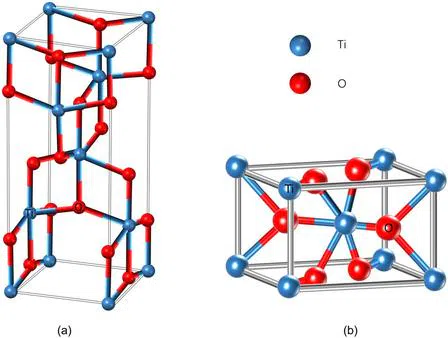
The critical differentiator for exterior applications lies in photostability. Rutile’s more compact crystal lattice—two molecules per unit cell versus four for anatase—renders it substantially less photocatalytically active. When exposed to UV radiation, anatase generates reactive oxygen species that degrade surrounding binder systems, causing chalking and premature color fade. This makes rutile the default specification for architectural exterior coatings, automotive finishes, and any plastic component with long-term outdoor exposure. Anatase remains relevant in specific niches: interior high-gloss paints where its slightly bluer undertone is preferred, and photocatalytic applications where its higher reactivity is the desired property.
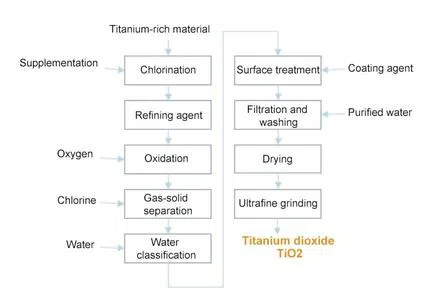
Beyond crystal form, the manufacturing process introduces another performance dimension. Chloride-process rutile pigments deliver tighter particle size distribution, higher brightness, and superior gloss compared to sulfate-process equivalents. The chloride route now represents the fastest-growing segment globally, with a projected CAGR of 4.3% through 2031. For exterior coatings and PVC profiles exposed to sunlight, the additional cost of a chloride-grade pigment is typically justified by extended service life and reduced maintenance. Sulfate-process grades remain cost-effective for interior applications and general-purpose plastics where UV exposure is minimal.
What B2B Buyers Should Watch in 2026: Pricing, Compliance, and Supply Chain Risks
Procurement teams entering 2026 face a fundamentally different sourcing environment than the preceding three years. Pricing dynamics have shifted from buyer’s market to balanced market conditions, with major Western producers implementing price increases of USD 100–150 per tonne on various grades in late 2025 and early 2026. The global titanium dioxide market experienced a sustained upward pricing trajectory through the first half of 2026, with international majors implementing cumulative increases of up to USD 400 per tonne in Asia-Pacific markets. However, buyers should note that this round of price escalation has been driven primarily by systematic supply-side contraction and raw material cost shocks—particularly sulfur and sulfuric acid prices—rather than by robust end-market demand expansion.
Cost pressures have hit sulfate-process producers disproportionately hard, as their production economics depend heavily on sulfuric acid feedstock. This has narrowed the historical price gap between chloride and sulfate grades, making the chloride premium more difficult to justify for purely cost-sensitive applications. Procurement managers should calculate total cost of ownership rather than comparing unit prices in isolation, factoring in shipping, import duties, rework risks, and production downtime associated with quality failures.
On the compliance front, regulatory divergence across major markets demands careful supplier qualification. The European Union’s suspension of E171 (food-grade Titanium Dioxide) in 2022 created uncertainty, yet the U.S. FDA completed its re-evaluation and publicly stated it does not have a safety concern with Titanium Dioxide and has no plans to restrict its use. For food-contact polymer applications, buyers should verify that pigment grades comply with 21 CFR 178.3297 (Colorants for Polymers) and check specific surface treatment chemistry. Grades carrying trimethylolpropane (TMP) surface treatments, for example, require additional migration risk assessment under EU Regulation No 10/2011. Beyond food-contact applications, the European Chemicals Agency (ECHA) continues to enforce REACH compliance for industrial-grade Titanium Dioxide imports, requiring full substance registration and safety data sheet documentation. For suppliers targeting EU markets, REACH registration is a non-negotiable prerequisite for market access, and buyers should independently verify registration numbers against the ECHA database rather than relying solely on supplier declarations.
Supply chain reliability has become a differentiator. Late shipments disrupt downstream operations and increase holding costs, and a reorder rate of only 13% among some suppliers indicates challenges in long-term contract retention. Buyers should prioritize suppliers with demonstrated batch-to-batch consistency, third-party lab reports, and—ideally—willingness to accommodate facility audits. Requesting ICP-MS analytical data for heavy metal content, particularly lead and arsenic, provides a quantitative basis for comparing suppliers beyond price.
How to Match Titanium Dioxide Grades to Your Application
The optimal titanium dioxide grade varies significantly across downstream industries. Understanding the interplay between crystal form, manufacturing process, and surface treatment is essential for maintaining product quality while controlling formulation costs.
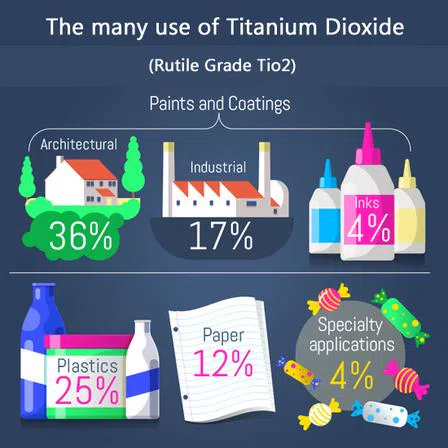
Paints and Coatings represent the largest Titanium Dioxide end-use segment at 58.6% of global consumption in 2025. For exterior architectural coatings, a chloride-process rutile grade with alumina-silica surface treatment delivers maximum durability and gloss retention. Interior flat wall paints can economically utilize sulfate-process rutile with medium chalk resistance, while high-gloss interior enamels may benefit from anatase’s bluer undertone.
Plastics and Packaging applications demand pigments with excellent dispersion in polymer matrices and minimal impact on mechanical properties. Rutile Titanium Dioxide with appropriate surface treatment ensures uniform color and UV protection in products ranging from PVC profiles to polyethylene packaging. For food-contact plastics, procurement teams must specify grades holding current FDA food-contact compliance under 21 CFR 178.3297.
Inks require Titanium Dioxide grades with fine particle size distribution—typically D50 in the range of 150–350 nm—to achieve smooth dispersion in binder systems. Rutile grades offer superior hiding power and color strength compared to anatase, making them the preferred choice for packaging and publication inks. Key performance criteria include long-lasting non-yellowing, good moisture resistance, and strong covering power.
Water Treatment and Photocatalysis applications represent a growing niche, where anatase Titanium Dioxide and mixed-phase formulations with high specific surface area (50–100 m²/g) are preferred for their photocatalytic activity. Sub-micro Titanium Dioxide particles annealed at approximately 550°C have demonstrated photocatalytic activity comparable to commercial P25 at loading conditions of 2–4 g/L, with the added advantage of easier post-treatment separation via simple sedimentation.
Cosmetics and Personal Care applications require rutile Titanium Dioxide with precisely controlled particle size (0.26–0.42 μm for micron-sized grades) and lipophilic surface treatment for oil-phase compatibility. Heavy metal content must be strictly controlled, with lead content not exceeding 5 ppm and mercury not exceeding 1 ppm to meet international cosmetic safety standards.
FAQ: Common Questions from B2B Buyers
Q1: What is the difference between rutile and anatase titanium dioxide for coatings?
Rutile Titanium Dioxide offers approximately 10–20% higher opacity per unit weight due to its higher refractive index (2.76 vs. 2.55), and significantly better UV resistance because its more compact crystal structure generates fewer reactive oxygen species under solar exposure. For exterior architectural coatings and automotive finishes, rutile is the industry standard. Anatase is limited to interior applications where its slightly bluer undertone is advantageous, or in photocatalytic coatings where surface reactivity is desired.
Q2: How do I verify if a Titanium Dioxide supplier meets FDA food-contact requirements?
Request a Certificate of Analysis (CoA) confirming compliance with 21 CFR 178.3297 for colorants in polymers. Verify that the surface treatment chemistry is approved for food-contact use—inorganic treatments such as silica and alumina are generally acceptable, while certain organic treatments may not be. Independent testing for heavy metals via ICP-MS is recommended as a verification step.
Q3: What is the current price outlook for Titanium Dioxide in 2026?
Prices have entered a recovery phase driven primarily by supply-side rationalization—approximately 600,000 tonnes of non-Chinese capacity have been permanently closed—rather than a surge in end-market demand. Major producers implemented increases of USD 100–150 per tonne on various grades in late 2025 and early 2026, with additional increases announced in Asia-Pacific and Latin American markets. Buyers should expect moderate upward price pressure through 2026, though the pace of increase is likely to decelerate in the second half as seasonal demand moderates.
Q4: Can I use the same Titanium Dioxide grade for both paints and plastics?
Not necessarily. While rutile Titanium Dioxide is the base specification for both applications, the optimal surface treatment differs significantly. Paints typically require alumina-silica surface treatments for weather resistance and dispersion in water-based or solvent-based systems. Plastics often benefit from organic surface treatments that improve compatibility with polymer matrices and reduce torque during extrusion. Using a paint-grade pigment in a plastic application may result in poor dispersion, visible agglomerates, and inconsistent color. Always confirm the recommended application with your supplier and request application-specific samples for testing.
Your Next Step: Source Titanium Dioxide with Verified Quality and Compliance
The 2026 titanium dioxide market rewards buyers who move beyond price comparison to total value assessment. Supply reliability, batch consistency, and regulatory compliance documentation now differentiate serious suppliers from opportunistic traders.
For procurement teams evaluating Titanium Dioxide suppliers, we recommend a structured qualification process: request application-specific samples for pilot testing, review third-party analytical reports (ICP-MS for heavy metals, laser diffraction for particle size distribution), and verify certification coverage including ISO 9001, ISO 14001, and REACH registration where applicable. For food-contact and cosmetic applications, confirm that the specific grade holds the necessary regulatory clearances—not merely that the supplier’s general product range does.
Contact our technical sales team today to request free Titanium Dioxide samples for your specific application, obtain complete technical data sheets and compliance documentation, or schedule a factory audit. We respond to all B2B inquiries within one business day.