
1. What Is Potassium Chloride?
Potassium chloride is an ionic compound with the chemical formula KCl. It consists of potassium ions and chloride ions arranged in a crystalline structure. In its pure form, it is generally white or colorless, odorless, and crystalline.
The compound occurs naturally in mineral deposits and concentrated brines. It can be recovered from suitable mineral resources and then processed to meet different industrial specifications. Depending on the intended application, manufacturers may supply standard crystals, fine powder, or granular products.
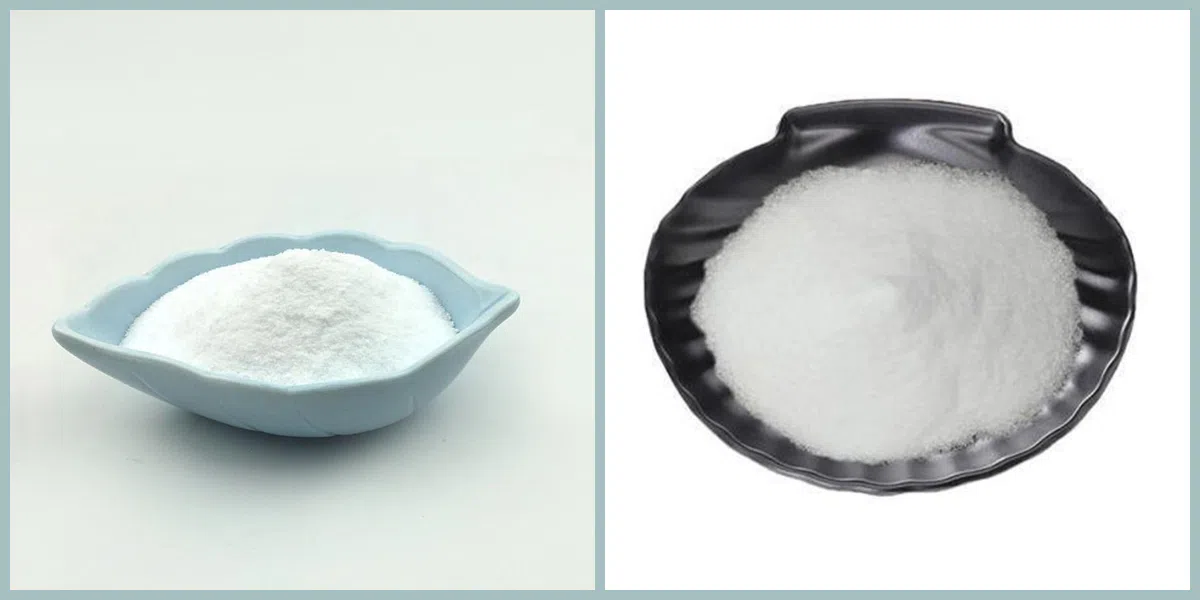
Industrial-grade potassium chloride is often selected for its consistent chemical composition and practical handling properties. A purity level of 99% or higher may be available for certain industrial products, although the exact specification should always be confirmed with the supplier.
Key Product Information
| Parameter | Typical information |
|---|---|
| Product name | Potassium Chloride |
| Chemical formula | KCl |
| CAS number | 7447-40-7 |
| Molecular weight | 74.55 g/mol |
| Appearance | White crystalline powder or granules |
| Odor | Odorless |
| Density | Approximately 1.98 g/cm³ |
| Melting point | Approximately 770°C |
| Boiling point | Approximately 1,420°C |
| Water solubility | Soluble in water |
| Chemical stability | Stable under normal conditions |
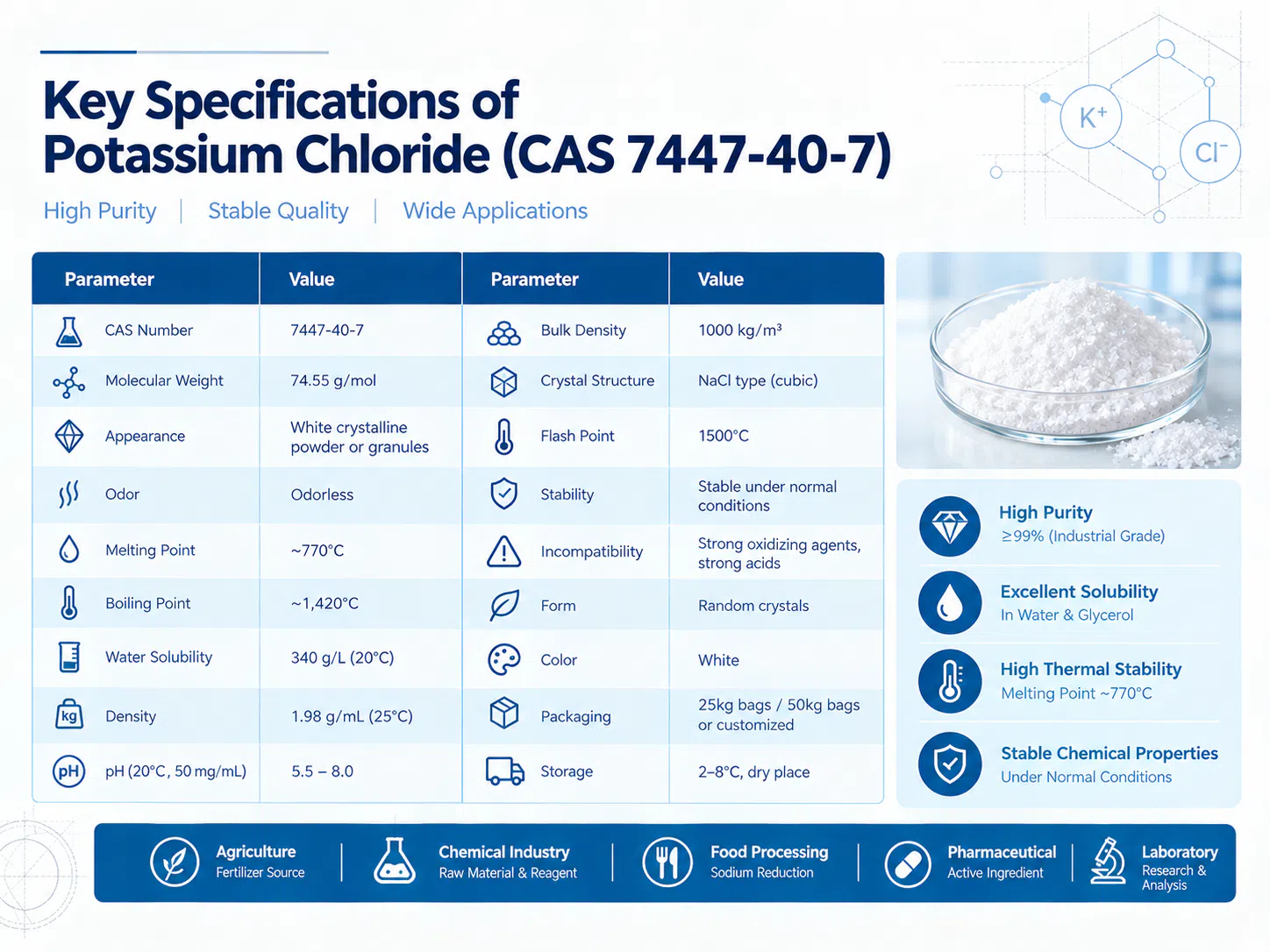
These values are general reference data. Actual commercial specifications can vary according to grade, test method, and supplier documentation. Buyers should request a current technical data sheet and certificate of analysis before placing an order.
2. Main Properties of Industrial Grade Potassium Chloride
2.1 High Purity and Consistent Quality
Purity is an important factor in industrial purchasing. A higher KCl content can help manufacturers control formulation ratios and reduce the effect of unwanted impurities. For applications that require accurate chemical composition, buyers should also review limits for sodium, magnesium, calcium, sulfate, and other relevant impurities.
Industrial Grade Potassium Chloride may be offered at a purity of at least 99%, according to the product specification provided by the supplier. However, this figure should not be treated as a universal standard for every KCl product.
When comparing quotations, buyers should confirm whether the stated purity is based on the material as received or on a dry basis. They should also check the analytical method and the acceptable limits for moisture and insoluble matter.
2.2 Good Water Solubility
Potassium chloride dissolves readily in water. This property makes it suitable for preparing aqueous solutions, chemical formulations, and selected industrial process liquids.
Its solubility is temperature-dependent. The concentration that can be achieved in a solution therefore depends on the water temperature and other components present in the formulation. For commercial use, a small-scale dissolution test can help confirm whether the material meets process requirements.
The compound is also reported to dissolve in glycerol, while its solubility in ethanol is limited. It is generally considered insoluble in ether and acetone. These differences matter when a manufacturer chooses a solvent or develops a new formulation.
2.3 Thermal Stability
Potassium chloride has a melting point of approximately 770°C and a boiling point near 1,420°C under commonly reported reference conditions. These properties reflect its ability to remain solid at normal processing temperatures.
Thermal stability is relevant to selected high-temperature chemical processes. However, a high melting point does not mean that every industrial application should operate at elevated temperatures. Processing conditions must be selected according to the full process design, equipment, and safety requirements.
2.4 Stable Chemical Properties
Under normal storage and handling conditions, potassium chloride is chemically stable. Its stability supports routine storage, transport, and use in many established processes.
The product should still be protected from unnecessary moisture, especially when a dry, free-flowing powder is required. Although the compound is generally stable, compatibility with other chemicals must be assessed before mixing. The supplied safety data sheet should guide storage, handling, and chemical compatibility decisions.
3. Major Applications of Potassium Chloride
3.1 Chemical Manufacturing
One important use of potassium chloride is as a raw material for producing other potassium compounds. Depending on the manufacturing route, it can be used in processes that produce potassium hydroxide and potassium carbonate, among other downstream chemicals.
These compounds serve different industries, including chemical processing, glass production, soaps, detergents, and specialty manufacturing. The suitability of a particular KCl supply depends on the purity, impurity profile, and process requirements of the receiving plant.
For manufacturers, consistent raw material quality can make production easier to control. A clear specification and reliable batch documentation can also support incoming-material inspection and quality management.
3.2 Agricultural Fertilizers
Agriculture is a major end-use market for potassium chloride. It is widely used as a source of potassium in fertilizer formulations. Potassium is an essential plant nutrient that supports several functions, including water regulation, enzyme activity, and normal plant development.
Fertilizer-grade products are not necessarily interchangeable with high-purity industrial materials. Agricultural products may be specified by nutrient content, particle size, granule strength, and suitability for blending or field application.
The correct fertilizer formulation depends on the crop, soil conditions, local recommendations, and the balance of nutrients already present. Buyers supplying the agricultural sector should therefore confirm the required grade and nutrient declaration before purchasing.
3.3 Food Processing and Sodium Reduction
Potassium chloride can be used in certain food applications, including some products designed to reduce sodium content. In suitable formulations, it can replace part of the sodium chloride used in a product.
However, food use requires an appropriate food-grade material and compliance with the regulations of the destination market. Industrial-grade material should not automatically be assumed suitable for food processing.
Taste, formulation performance, labeling rules, and permitted use levels must be considered by food manufacturers. Buyers should request relevant food-grade documentation and confirm regulatory acceptance before approving a supplier.
3.4 Pharmaceutical Preparations
Potassium chloride is used in pharmaceutical products where potassium is an active or functional ingredient. These applications require careful control of composition and product quality.
Pharmaceutical use is subject to applicable pharmacopeial standards, manufacturing controls, and regulatory requirements. A general industrial purity claim does not demonstrate pharmaceutical suitability. Buyers should confirm the applicable grade, testing requirements, traceability, and supporting documentation before procurement.
3.5 Laboratory and Technical Applications
Potassium chloride is also used as a chemical reagent in laboratories and technical processes. The required grade can differ according to the purpose of the test or production step.
Some procedures require tightly controlled impurity levels, while other routine applications may accept a standard technical grade. The purchasing specification should identify the required assay, impurity limits, packaging, and any special testing needs.
4. Industry Background and Market Trends
Potassium chloride serves several markets, but agricultural demand remains an important influence on the wider industry. Fertilizer consumption is linked to crop production, soil nutrient management, agricultural input costs, and the availability of potash resources.
Industrial demand also matters. Chemical manufacturers, food processors, pharmaceutical producers, and other technical users may require grades with different purity levels and physical properties.
Grand View Research estimated the global potassium chloride market at approximately USD 22.3 billion in 2024 and projected growth through 2033. This is a third-party market estimate rather than an official measurement of every KCl application, and its scope and methodology should be reviewed before using the figures in business forecasts. (Source: Grand View Research, Potassium Chloride Market.)
4.1 Demand for Application-Specific Grades
One notable purchasing trend is the need to match material specifications to the final application. Agricultural buyers may focus on nutrient content and granule characteristics. Industrial users may place greater emphasis on chemical purity, dissolution behavior, and impurity limits. Food and pharmaceutical buyers require additional grade-specific and regulatory documentation.
This means that suppliers need to communicate product specifications clearly. A single description such as “high purity” is not enough for every buyer. Detailed technical information helps customers evaluate whether a material fits their process.
4.2 Quality Control and Supply Reliability
Manufacturers increasingly need predictable raw materials to maintain stable production schedules. For buyers, this makes batch consistency, lead times, packaging integrity, and document availability important parts of supplier evaluation.
A practical purchasing process should include specification review, sample evaluation where appropriate, confirmation of available inventory, and agreement on shipment documentation. Long-term buyers may also benefit from establishing clear acceptance criteria before repeated orders.
4.3 Regional Demand and Supply Considerations
Demand patterns vary by region because agricultural production, industrial capacity, import dependence, and local regulations are different. Market reports commonly analyze Asia-Pacific, Europe, North America, Latin America, and the Middle East and Africa as separate regions.
For international buyers, market size alone does not determine whether a source is commercially suitable. Freight costs, import requirements, payment terms, supply continuity, and the ability to meet the required grade should also be evaluated.
5. Production and Quality Control Process
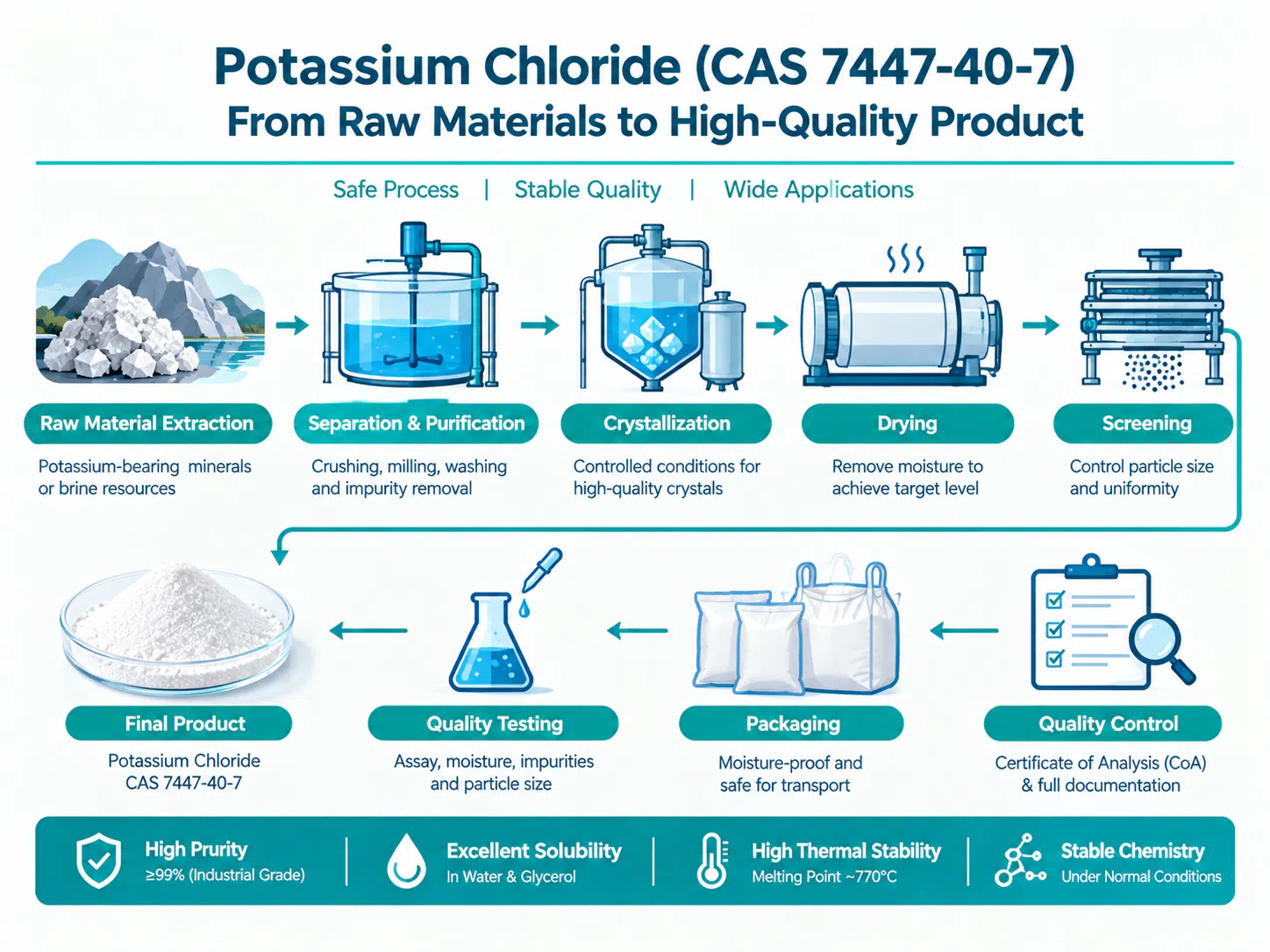
Potassium chloride is commonly recovered from potassium-bearing mineral deposits or concentrated brines. The exact process depends on the source material and the desired product grade.
5.1 Raw Material Extraction
The process begins with suitable mineral resources or brines. Raw material selection affects the initial composition and the type of impurities that may need to be removed.
5.2 Separation and Purification
For mineral-based production, processing may include crushing, milling, washing, screening, and separation methods such as flotation. Brine-based processes may use concentration and crystallization steps. The specific process depends on the feedstock and production facility.
The objective is to separate potassium chloride from unwanted components and achieve the required product composition.
5.3 Crystallization and Drying
Where the production route uses crystallization, controlled conditions help form crystals of the required size and quality. The material may then be separated from the process liquid and dried.
Moisture control is important because excessive moisture can affect flow, storage behavior, and weighing accuracy. The final particle size should match the needs of the intended application.
5.4 Screening, Testing, and Packaging
The product may be screened to obtain a target particle-size range before final packaging. Quality control commonly includes testing for KCl content and relevant impurities, with additional tests selected according to the product specification.
Industrial buyers should request a certificate of analysis (CoA) for the supplied batch. Depending on the application, other useful documents may include a technical data sheet (TDS), safety data sheet (SDS), and applicable compliance declarations.
6. How to Select a Reliable Potassium Chloride Supplier
Choosing a supplier involves more than comparing the quoted price per metric ton. A lower purchase price may not offer good value if the material fails incoming inspection or causes processing problems.
6.1 Confirm the Required Grade
Start by defining the application. Industrial processing, agriculture, food production, pharmaceuticals, and laboratory work may require different specifications. Confirm the grade before requesting a quotation.
6.2 Review the Certificate of Analysis
The CoA should identify the tested batch and report the parameters relevant to the agreed specification. Check the assay, moisture content, impurity limits, and testing methods where applicable.
6.3 Evaluate Physical Form and Packaging
Powder, crystals, and granules can behave differently during transport, feeding, blending, and dissolution. Buyers should specify the desired particle size and packaging format. Packaging should also provide suitable protection against moisture and contamination during storage and shipment.
6.4 Check Documentation and Delivery Terms
International orders may require commercial invoices, packing lists, transport documents, and other records according to the shipment and destination. Confirm the supplier's ability to provide the documents required by your company and local import procedures.
Buyers should also agree on order quantity, lead time, delivery terms, payment conditions, and procedures for handling non-conforming material.
7. Storage, Handling, and Safety
Potassium chloride should be stored in a suitable, dry area and protected from unnecessary moisture. Keep containers closed when not in use and use packaging that is appropriate for the product and the storage environment.
Avoid contamination from other materials. Chemical compatibility should be assessed before blending or processing, particularly where strong oxidizing agents or other reactive chemicals are present. Workers should follow the product-specific SDS and site procedures for personal protective equipment, spill response, and disposal.
The product's suitability for a particular use must be established from the relevant grade specification. Industrial, food, and pharmaceutical products should not be treated as interchangeable solely because they share the same chemical formula.
8. Frequently Asked Questions
Q1: What is the CAS number of potassium chloride?
The CAS number is 7447-40-7. It identifies the chemical substance for product records, technical documentation, and procurement. Buyers should still verify the full product specification before placing an order.
Q2: What purity is available for industrial potassium chloride?
Industrial products may be offered at 99% purity or higher, depending on the supplier and grade. Buyers should confirm the assay, impurity limits, and test methods on the current technical data sheet and certificate of analysis.
Q3: Is potassium chloride soluble in water?
Yes. Potassium chloride is readily soluble in water. Its solubility varies with temperature, so users developing a concentrated solution should calculate the required concentration and confirm process conditions before production.
Q4: Can industrial potassium chloride be used in food or pharmaceutical products?
Not automatically. Food and pharmaceutical applications require grades that meet the applicable quality and regulatory standards. Buyers should obtain the correct documentation and confirm that the product is approved for the intended use in the destination market.
Conclusion
Potassium chloride is a versatile inorganic salt with applications in chemical manufacturing, agriculture, food processing, pharmaceuticals, and laboratory work. Its water solubility, crystalline form, and stable behavior under normal conditions make it useful across a broad range of processes.
For B2B buyers, the most important purchasing steps are to define the intended application, confirm the required grade, review batch quality documents, and evaluate packaging and delivery capability. These checks help reduce quality risks and improve supply planning.
If your company is sourcing Potassium Chloride CAS 7447-40-7, prepare your target purity, application, particle-size requirements, packaging preference, and estimated order quantity before requesting a quotation. A clear specification allows suppliers to provide a more relevant offer and helps both sides establish a reliable long-term business relationship.


