
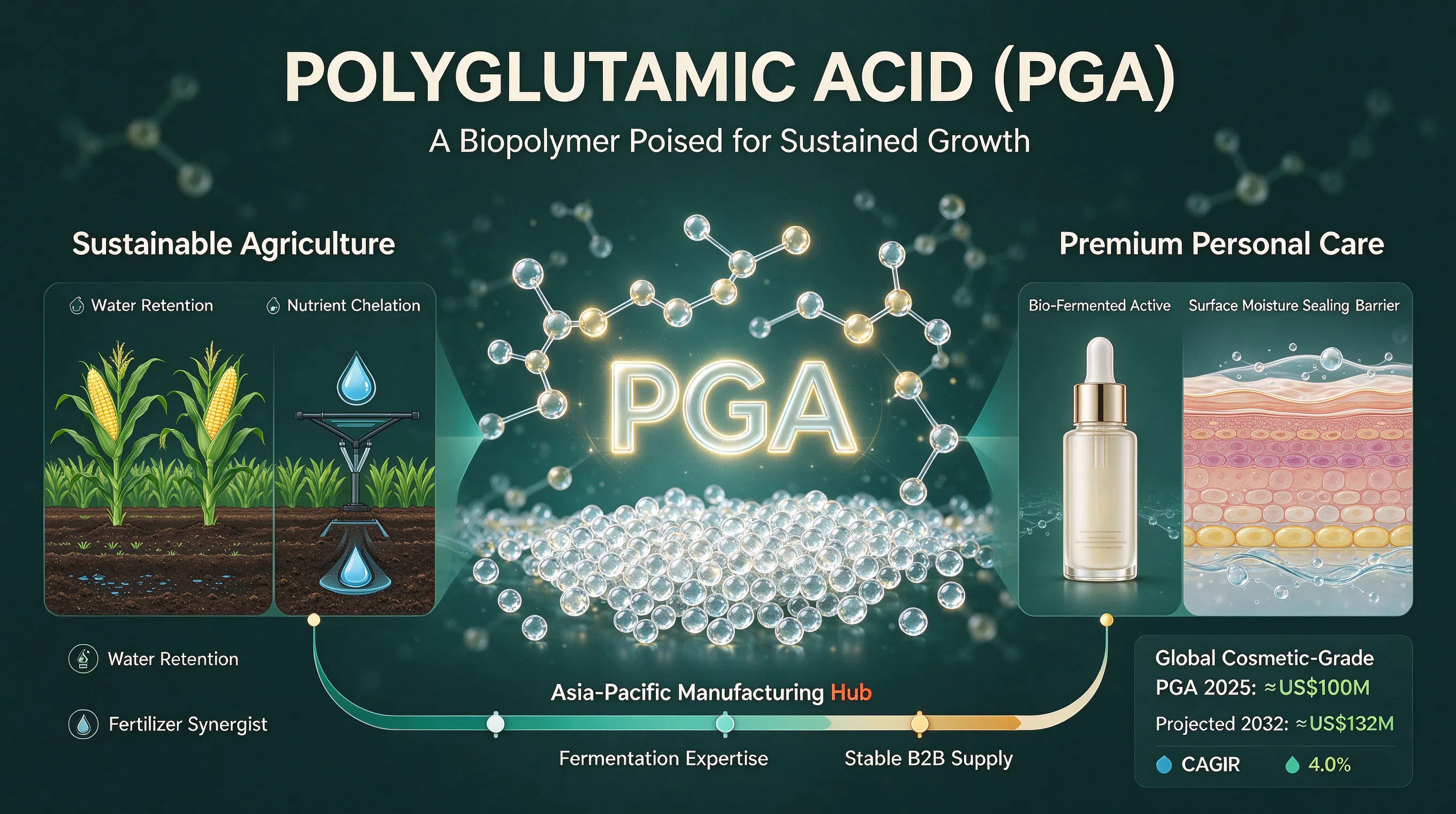
Global Market Overview: A Biopolymer Poised for Sustained Growth
Several structural drivers underpin this growth. The global shift toward sustainable agricultural practices—accelerated by government subsidies, organic certification requirements, and rising awareness of chemical fertilizer pollution—has positioned PGA as a preferred eco-friendly alternative.In the personal care sector, consumer demand for bio-fermented, barrier-protective actives has elevated PGA from a niche humectant to a headline ingredient in premium skincare formulations.
Asia-Pacific dominates PGA manufacturing, particularly China and Japan, where mature Bacillus fermentation know-how, dense industrial biotech ecosystems, and cost-efficient feedstock supply chains provide significant production advantages.For international B2B buyers, this concentration translates into competitive pricing and stable supply—but also necessitates careful supplier evaluation to ensure batch consistency and regulatory compliance.
Technical Profile: Understanding γ-PGA at the Molecular Level
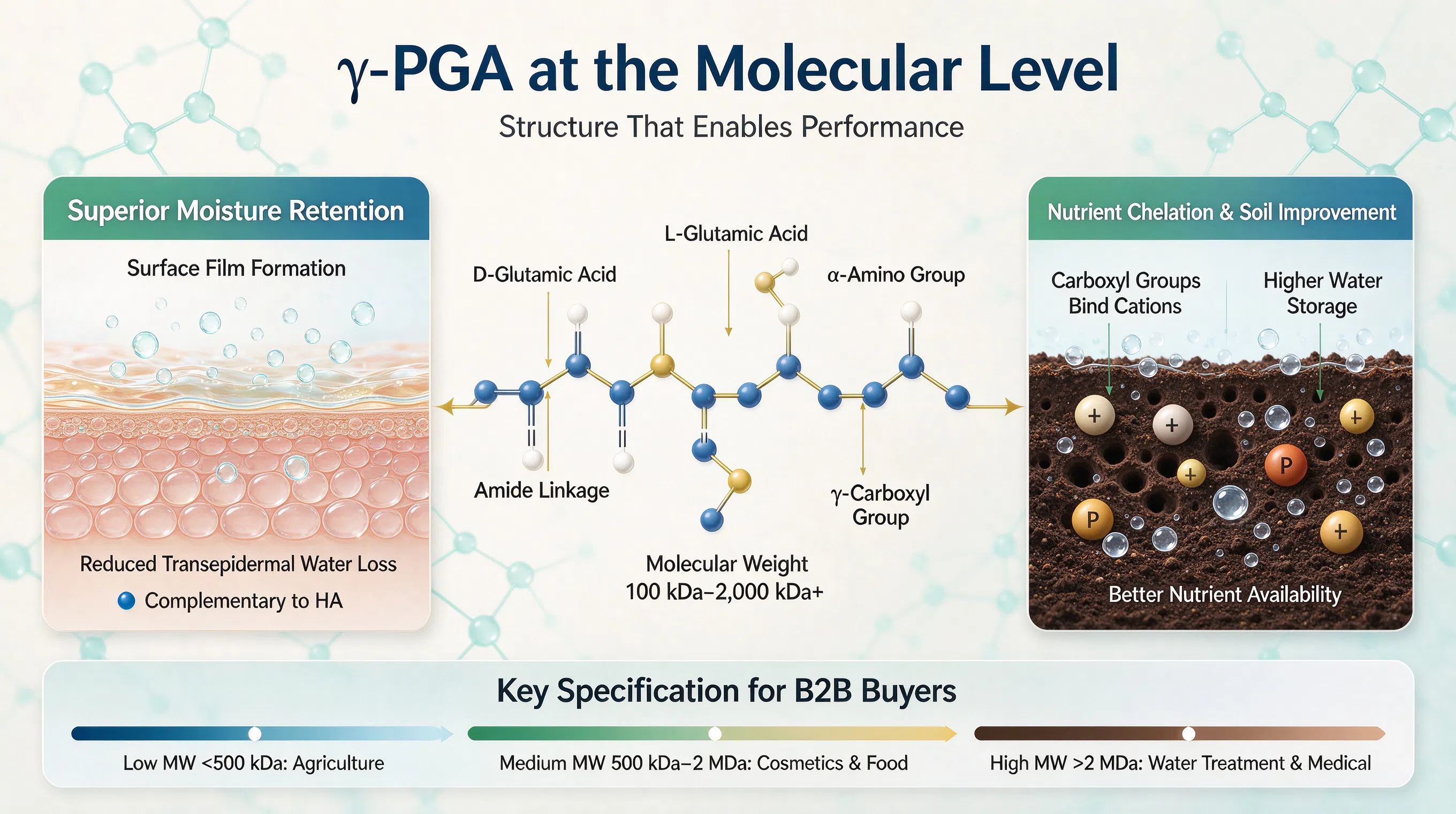
Polyglutamic acid (CAS#25513-46-6) is a water-soluble, biodegradable biopolymer produced through microbial fermentation, typically using Bacillus subtilis cultured on L-glutamic acid as a substrate.Structurally, it is a homo-polyamide composed of D- and L-glutamic acid monomers connected by amide linkages between α-amino and γ-carboxyl groups, with molecular weight typically ranging from 100 kDa to over 2,000 kDa.
This structural configuration confers several distinctive properties that differentiate PGA from conventional polymers:
Superior Moisture Retention. PGA forms a moisture-sealing film on the skin surface and holds water molecules at the stratum corneum. Comparative studies indicate that PGA's hydrating effect is superior to sodium hyaluronate and collagen, with some sources reporting hydration capacity up to 500 times its own weight.Unlike hyaluronic acid, which primarily draws moisture into deeper skin layers, PGA works at the surface, preventing transepidermal water loss—they function as complementary rather than competing ingredients.
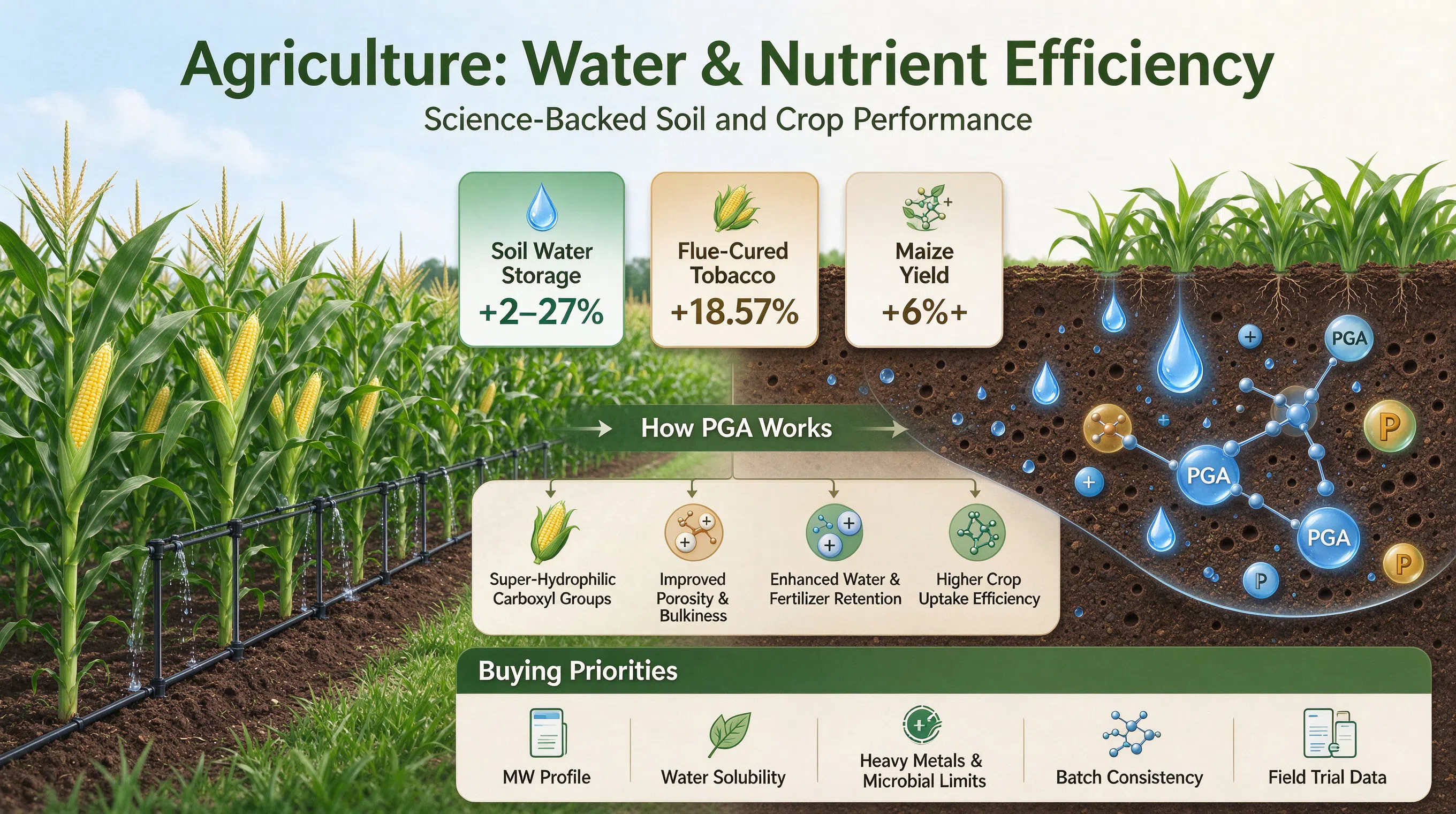
Nutrient Chelation and Soil Improvement. In agricultural applications, PGA's abundant carboxyl groups chelate cations, improving the availability of phosphorus, calcium, and micronutrients while reducing soil nitrogen leaching. Field studies have demonstrated that γ-PGA application significantly increases soil water storage (by 2–27%), soil pore number (by up to twelvefold for pores larger than 1,000 μm), and maize grain weight (by 12–37%).
Full Biodegradability. PGA degrades into glutamic acid, a naturally occurring amino acid, leaving no residual environmental burden. This biodegradability is central to its regulatory acceptance and commercial viability in both agriculture and personal care.
Molecular weight is the single most important purchasing specification for B2B buyers. The following table summarizes typical molecular weight ranges by application:
| Molecular Weight Range | Grade / Application | Typical Dosage |
|---|---|---|
| < 500,000 Da (Low) | Agriculture (soil/plant conditioner) | 20–80 kg/ha |
| 500,000–2,000,000 Da (Medium) | Cosmetics, food, healthcare | 0.05%–1.00% |
| > 2,000,000 Da (High) | Water treatment, medical devices | Application-specific |
Agriculture: A Science-Backed Solution for Water and Nutrient Efficiency
For agricultural B2B buyers—fertilizer manufacturers, distributors, and large-scale farming operations—γ-PGA represents a practical response to three converging pressures: water scarcity, fertilizer price volatility, and regulatory restrictions on synthetic inputs.
How PGA Improves Soil and Crop Performance
γ-PGA's mechanism of action in soil is multifaceted. Its super-hydrophilic carboxyl groups maintain soil moisture, improve soil porosity and bulkiness, and enhance water and fertilizer retention capacity.When applied as a fertilizer synergist, PGA increases crop uptake efficiency of phosphorus and calcium. Documented field results include a 18.57% yield increase in flue-cured tobacco and over 6% yield improvement in maize.Under mulched drip irrigation conditions, γ-PGA prolonged active grain filling by 1–3 days and increased water use efficiency by 1.0–18.1%.
For buyers formulating compound fertilizers or soil conditioners, PGA integrates readily into existing production lines as a powder or liquid additive. Recommended application rates vary by crop, soil type, and irrigation method; suppliers should provide region-specific trial data to support dosage optimization.
Key Purchasing Considerations for Agricultural-Grade PGA
When sourcing agricultural-grade Polyglutamic Acid for fertilizer or soil amendment applications, buyers should prioritize:
Molecular weight profile: Lower molecular weight fractions (< 500,000 Da) typically exhibit faster soil mobility and are preferred for fertigation systems, while medium-weight fractions offer longer-lasting soil conditioning.
Purity and contamination screening: Heavy metal content, microbial limits, and residual fermentation substrates must comply with destination-market regulations (EU Fertilising Products Regulation, US EPA, etc.).
Water solubility: Complete solubility is essential for liquid fertilizer formulations and drip irrigation compatibility.
Batch-to-batch consistency: Viscosity and molecular weight distribution should be verified via GPC or viscometry testing across production lots.
Cosmetics and Personal Care: The Next-Generation Humectant
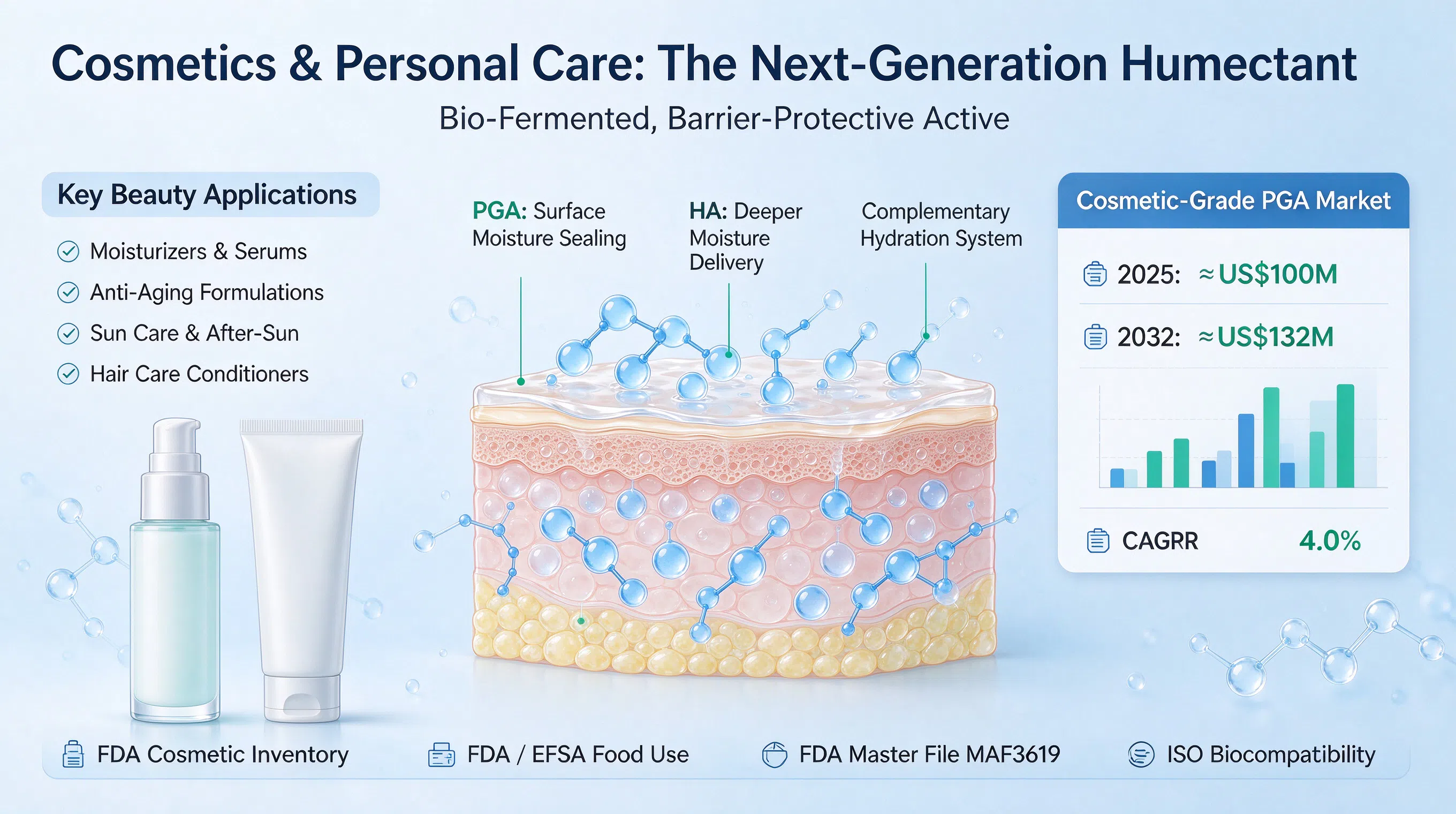
In the cosmetics industry, Polyglutamic Acid has moved from a specialty ingredient to a mainstream active. Global cosmetic-grade PGA market sales reached approximately US$100 million in 2025 and are projected to reach US$132 million by 2032, growing at a CAGR of 4.0%.
In the cosmetics industry, Polyglutamic Acid has moved from a specialty ingredient to a mainstream active. Global cosmetic-grade PGA market sales reached approximately US100millionin2025andareprojectedtoreachUS 132 million by 2032, growing at a CAGR of 4.0%.
Why Formulators Are Adopting PGA
The consumer shift toward "skin barrier" and "bio-fermented" positioning has created strong demand for actives that deliver measurable hydration without irritation risk. PGA fulfills this requirement across multiple product categories:
Moisturizers and serums: PGA provides long-lasting hydration, improves skin elasticity, and reduces wrinkle appearance. Recommended dosage ranges from 0.05% to 1.00% in finished formulations.
Anti-aging products: PGA/HA hydrogel systems have demonstrated the ability to remodel extracellular matrix, promote fibroblast viability, and inhibit TNF-α, supporting anti-skin-aging claims with empirical evidence.
Sun care and after-sun: PGA's film-forming and soothing properties make it suitable for protective and calming formulations.
Hair care: PGA functions as a moisturizer and protective film former in conditioners and treatments.
Regulatory Status and Buyer Confidence
PGA is fully listed on the safe inventory of approved raw cosmetic materials in major markets. In the United States, no FDA concentration limits are imposed for cosmetic humectant use. Food-grade PGA is approved for use as a thickening agent, stabilizer, and film-forming agent by regulatory bodies including the FDA and EFSA.Medical-grade PGA has obtained FDA Master File registration (MAF3619), confirming its biocompatibility through ISO testing including cytotoxicity, skin sensitization, and intracutaneous reactivity assessments.
Manufacturing and Quality Assurance
Polyglutamic Acid is produced through liquid fermentation using Bacillus subtilis or Bacillus licheniformis strains. The microbial synthesis pathway proceeds through three stages: precursor synthesis, polymerization transfer, and catabolism.Industrial fermentation typically employs fed-batch cultivation with glucose as the carbon source and corn steep liquor or other nitrogen sources, achieving yields suitable for commercial-scale production.
For B2B buyers, supplier qualification should encompass:
Fermentation capacity: Verified production scale (tons/year) and evidence of stable, reproducible fermentation runs.
Purification capability: Ability to deliver consistent molecular weight fractions and low endotoxin levels for pharmaceutical applications.
Quality documentation: Full COA, MSDS, and third-party testing reports for each production lot.
Certifications: ISO 9001, Kosher, Halal, and organic certifications as required by destination markets.
Regulatory support: Assistance with product registration and compliance documentation for target countries.
Frequently Asked Questions (FAQ)
Q1: What is the difference between Polyglutamic Acid (PGA) and Hyaluronic Acid (HA) in cosmetic formulations?
Both are humectants, but they function at different skin depths. Hyaluronic acid draws moisture into deeper skin layers, while Polyglutamic Acid holds moisture at the surface and forms a film that reduces transepidermal water loss.PGA is a considerably larger molecule than most HA forms used in serums, and laboratory comparisons indicate superior water-holding capacity per gram. Using both in combination delivers more comprehensive hydration than either alone.
Q2: What is the recommended dosage of Polyglutamic Acid in agricultural applications?
The optimal application rate depends on soil conditions, crop type, and irrigation method. Research under mulched drip irrigation recommends approximately 70 kg/ha for maize, with field trials demonstrating yield increases of 4.9–21.8% and water use efficiency gains of 1.0–18.1%.For fertilizer formulations, we recommend conducting region-specific field trials to determine the optimal inclusion rate.
Q3: Is Polyglutamic Acid safe and compliant for use in food and personal care products?
Yes. Polyglutamic acid is biodegradable and non-toxic. In cosmetics, it is listed on the safe inventory of approved raw materials with no FDA concentration limits for humectant use. Food-grade PGA is approved by the FDA and EFSA as a thickening agent and stabilizer.Medical-grade PGA has secured FDA Master File registration, confirming ISO-standard biocompatibility.
Q4: What molecular weight of Polyglutamic Acid should I specify for my application?
Molecular weight determines performance characteristics. For cosmetics and food applications, 500,000–2,000,000 Da is typical. For agricultural soil conditioning and fertilizer synergists, lower molecular weights (< 500,000 Da) offer faster soil mobility. For water treatment and medical device applications, high molecular weight (> 2,000,000 Da) provides superior flocculation and film-forming properties.
Q5: What is the typical MOQ and lead time for bulk Polyglutamic Acid orders?
MOQ varies by supplier and grade. Most Chinese manufacturers accept orders starting from 1 kg for sample evaluation, with bulk pricing tiers typically beginning at 100 kg and above. Standard lead time is 2–5 business days for stock items; custom specifications may require 15–30 days.
Take Action: Request Your Polyglutamic Acid Sample and Technical Data Package
Whether you are formulating the next generation of water-efficient fertilizers, developing a premium skincare range, or sourcing raw materials for pharmaceutical applications, Polyglutamic Acid (CAS#25513-46-6) offers a scientifically validated, regulatory-compliant, and commercially scalable solution.
Contact our technical sales team today to:
Request a free sample (shipping cost to be covered by buyer) for your application-specific evaluation
Obtain a comprehensive technical data package including COA, MSDS, molecular weight distribution analysis, and application guidelines
Discuss custom molecular weight specifications and packaging requirements (1 kg aluminum foil bags to 25 kg fiber drums, with OEM/ODM options available)
Receive a competitive quotation for bulk quantities with volume-based pricing
Your next product innovation may start with a single gram. Let us help you evaluate it.


