
Sodium Bicarbonate CAS 144-55-8: Uses and Market Trends
Sodium bicarbonate is a widely used inorganic chemical with applications across food processing, pharmaceuticals, animal feed, environmental treatment, fire protection, and industrial manufacturing. Its chemical formula is NaHCO₃, and its CAS number is 144-55-8.
Although many consumers know it simply as baking soda, industrial buyers need to look beyond the common name. Different industries require different grades, purity levels, particle sizes, packaging formats, and documentation.
For international B2B buyers, these differences are becoming increasingly important. Current market studies show that demand is supported by several end-use sectors rather than one single industry. Food and beverages remain a major application area, while pharmaceutical, environmental, feed, and industrial uses continue to create additional demand.
This article reviews the material's identity, major applications, manufacturing process, market development, and key purchasing considerations.
What Is Sodium Bicarbonate CAS 144-55-8?
Sodium bicarbonate CAS 144-55-8 is a white inorganic compound with the chemical formula NaHCO₃. It is also known as sodium hydrogen carbonate or baking soda.
The material has mild alkaline properties and can react with acids to produce carbon dioxide. This basic chemical behavior explains many of its commercial applications.
For example, food manufacturers can use it as a leavening agent and acidity regulator. Pharmaceutical manufacturers can use suitable grades in formulations that require bicarbonate functionality. Industrial users may use it for neutralization, pH adjustment, cleaning formulations, or environmental treatment.
However, buyers should not treat all sodium bicarbonate products as interchangeable.
A food manufacturer may require food-grade material with specific regulatory documentation. A pharmaceutical company may need tighter specifications and a qualified quality system. An industrial customer may focus more heavily on particle size, bulk density, assay, moisture, and cost efficiency.
This makes grade selection one of the first questions that should be addressed during procurement.
Market Background and Current Industry Development
The global market for sodium bicarbonate has a broad industrial base. According to Fortune Business Insights, the global market was valued at approximately USD 4.13 billion in 2025 and is projected to reach USD 6.40 billion by 2034, with a forecast CAGR of about 5.0% over the period. The same source reports that Asia Pacific represented 31.47% of the market in 2025.
Another market analysis provides a different estimate, placing the 2025 market at approximately USD 5.08 billion and forecasting growth to USD 6.82 billion by 2031. The difference illustrates an important point for B2B readers: market-size estimates can vary because research companies use different methodologies, definitions, geographic coverage, and segmentation models.
Despite the differences between estimates, the broader direction is similar. Demand is distributed across food, pharmaceuticals, feed, environmental treatment, and industrial applications.
This diversification provides a relatively broad demand base for manufacturers and distributors.
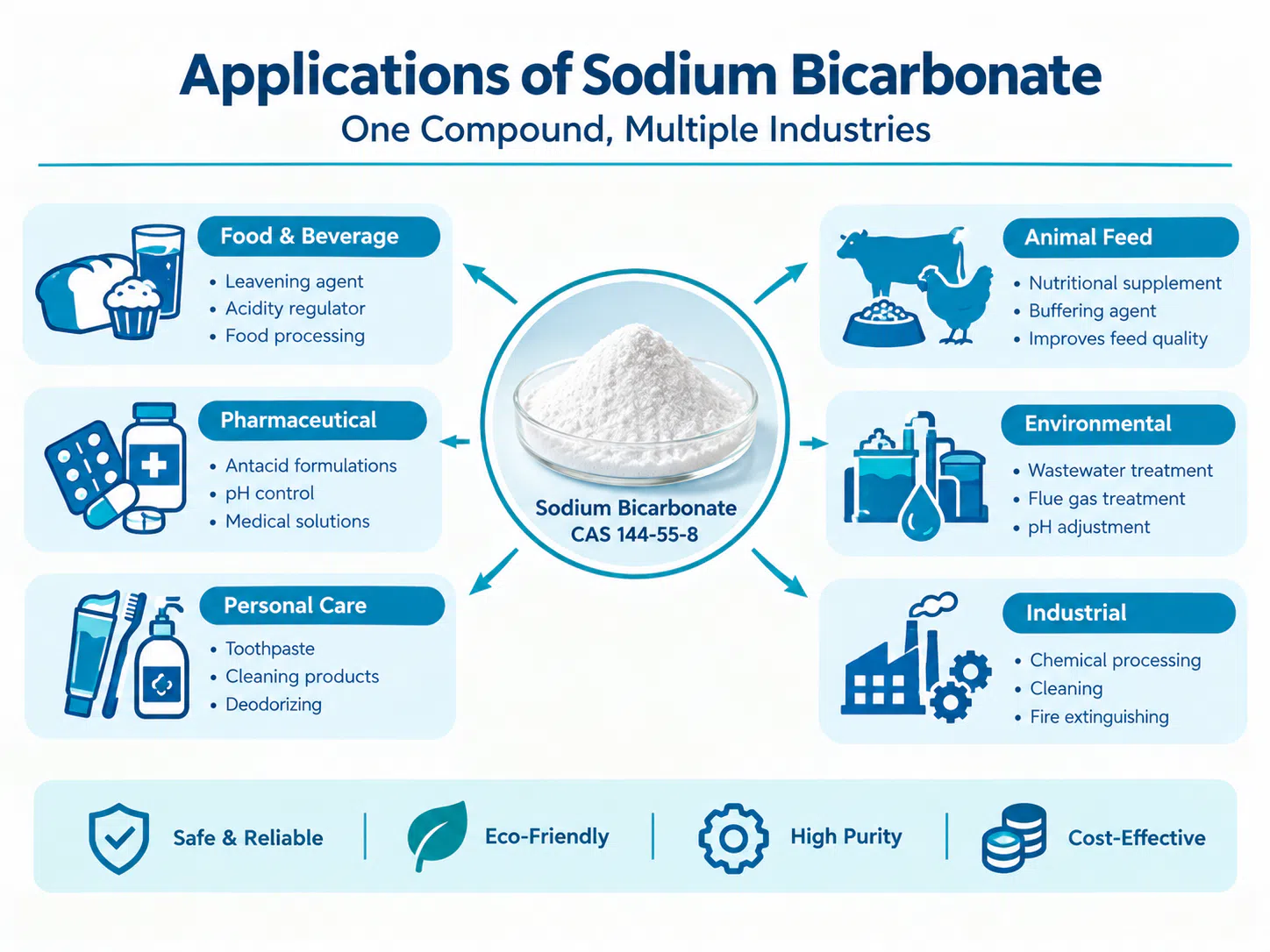
Major Sodium Bicarbonate Uses in Global Industries
Food and Beverage Processing
Food processing is one of the largest commercial applications.
In baking, sodium bicarbonate can release carbon dioxide when it reacts with acidic ingredients. The gas helps create a lighter structure in products such as cakes, biscuits, and other baked foods.
It can also be used for acidity regulation and processing functions in suitable food formulations. Tata Chemicals lists food manufacturing and beverages among its key application areas.
Market research from Mordor Intelligence estimates that food and beverages accounted for 32.48% of the sodium bicarbonate market in 2025. Food-grade material therefore remains an important purchasing category for manufacturers serving this sector.
For B2B buyers, important considerations include:
- Food-grade compliance
- Purity and impurity limits
- Particle size
- Moisture
- Packaging
- Batch consistency
- Regulatory documentation
The exact requirements should be matched to the destination market and final application.
Pharmaceutical Applications
Pharmaceutical applications require a different purchasing approach.
Suitable pharmaceutical-grade sodium bicarbonate can be used in antacid formulations, pH-control systems, medical solutions, and other pharmaceutical processes. Tata Chemicals, for example, identifies pharmaceutical applications including antacid formulations and pH control.
Current market analysis also points to pharmaceutical-grade material as a growing segment. Mordor Intelligence projects pharmaceutical-grade sodium bicarbonate to grow at approximately 6.55% CAGR from 2026 to 2031.
For pharmaceutical buyers, price alone is rarely sufficient for supplier qualification. Documentation, traceability, manufacturing controls, testing capability, and consistency between batches can be equally important.
Therefore, a supplier serving this segment should be able to provide appropriate technical and quality documents before commercial approval.
Animal Feed and Nutrition
Another established application is animal feed.
Feed manufacturers can use appropriate grades as a source of sodium and as part of buffering strategies in livestock and poultry diets. Commercial suppliers therefore often separate feed-grade material from food-grade and industrial-grade products.
For international buyers, the key issue is not simply whether the product is chemically sodium bicarbonate. The material must also meet the requirements applicable to the intended feed market.
This can include documentation, traceability, purity requirements, packaging, and destination-country regulations.
The continued development of intensive livestock production is one factor supporting demand for feed-related applications.
Environmental and Industrial Applications
Environmental applications are becoming increasingly relevant.
Sodium bicarbonate can be used in flue-gas treatment to neutralize acidic components in industrial emissions. Fine material can be introduced into appropriate gas-treatment systems, where its reaction with acidic pollutants supports emission-control processes.
Current market research identifies flue-gas treatment and emission control as important areas of industrial demand.
Technical-grade sodium bicarbonate is also used in areas such as:
- Chemical processing
- Cleaning products
- Fire extinguishing formulations
- Textile processing
- Plastics manufacturing
- Water and environmental treatment
- Selected laboratory applications
Tata Chemicals identifies fire safety, flue-gas treatment, plastics, textiles, cleaning products, and other industrial uses in its sodium bicarbonate portfolio.
This diversity means industrial buyers should define the process requirement before selecting a supplier.
Sodium Bicarbonate Manufacturing Process
The production process can vary according to the raw-material source and production route.
The USDA's 2025 technical report explains that sodium bicarbonate can commonly be produced by passing carbon dioxide through a saturated solution of refined sodium carbonate. The resulting sodium bicarbonate precipitates and can then be separated through filtration or centrifugation, followed by drying, screening, and packaging.
A simplified production sequence is:
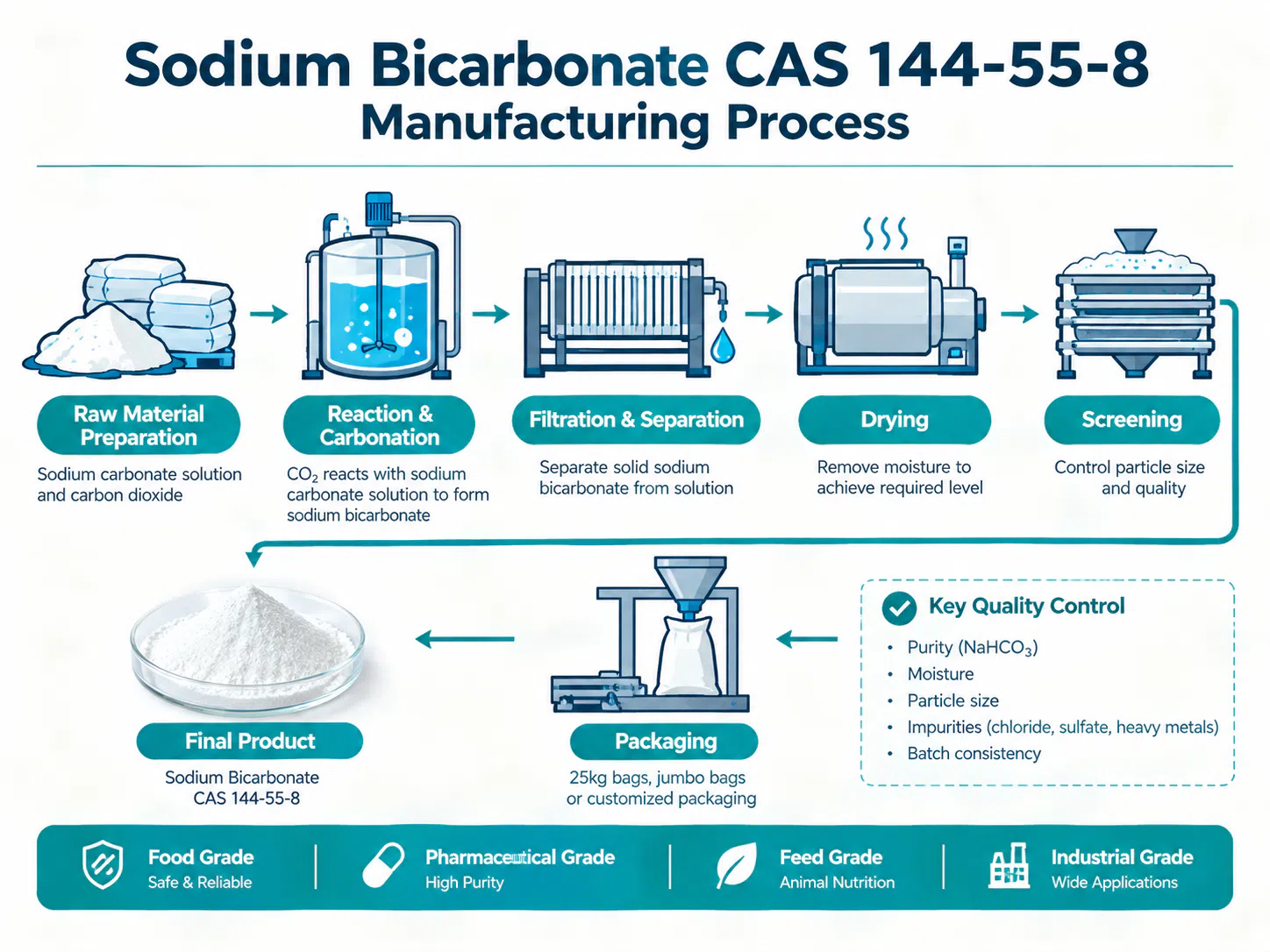
Sodium carbonate solution → Carbonation → Sodium bicarbonate precipitation → Filtration → Drying → Screening → Packaging
In the traditional Solvay route, sodium chloride, ammonia, and carbon dioxide are involved in producing sodium bicarbonate. The process includes carbonation and precipitation, followed by separation of the solid product. Ammonia can be recovered and recycled within the process.
The manufacturing process directly affects product properties.
Parameters such as crystallization conditions, filtration, drying, and screening can influence particle size, moisture, bulk density, and handling characteristics.
For B2B buyers, this is why a product specification sheet is more useful than relying only on the chemical name.
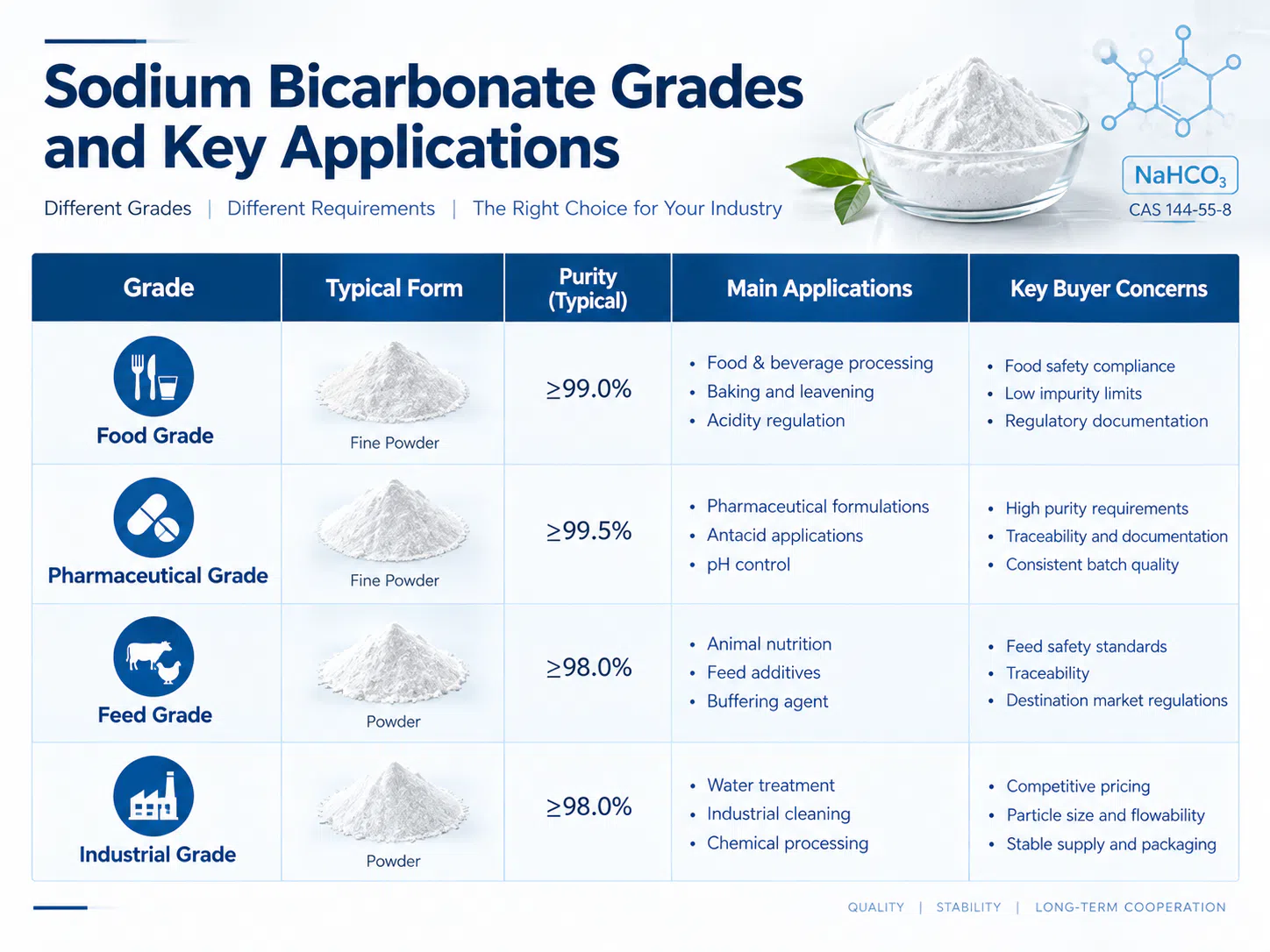
Product Grade and Specification Selection
A major purchasing decision is selecting the correct grade.
Food Grade
Food-grade material is intended for suitable food and beverage applications. Buyers should confirm applicable food standards, impurity limits, documentation, and destination-market requirements.
Pharmaceutical Grade
Pharmaceutical-grade material generally requires stricter quality control and documentation. Supplier qualification can also be more demanding.
Feed Grade
Feed-grade material is used in appropriate animal nutrition formulations. Buyers should confirm that the product and supporting documentation meet the requirements of the destination market.
Industrial Grade
Industrial-grade sodium bicarbonate can be used for applications such as environmental treatment, cleaning, chemical processing, and other industrial processes.
The key lesson for procurement teams is simple: the lowest quoted price does not necessarily represent the lowest overall purchasing cost.
A product that requires additional testing, creates handling problems, or fails to meet a customer's specification can create additional costs later.
Market Trends Affecting B2B Buyers
Increasing Demand for Specialty Grades
The market is gradually becoming more segmented.
Rather than selling one standardized material to every customer, producers are increasingly serving different requirements through food, pharmaceutical, feed, and technical grades.
This trend is especially relevant to buyers importing large volumes because the product specification should be linked directly to the final application.
Growth of Environmental Applications
Environmental regulations are supporting demand for chemicals used in emission-control systems.
Research from Mordor Intelligence identifies industrial applications as one of the faster-growing areas, with industrial demand projected to grow at approximately 6.52% CAGR from 2026 to 2031.
This creates opportunities for suppliers capable of providing suitable particle sizes and consistent material performance.
Greater Focus on Quality Documentation
International procurement is also becoming more documentation-driven.
Buyers increasingly need:
- Certificate of Analysis
- Safety Data Sheet
- Product specification
- Batch information
- Packaging information
- Regulatory documents
- Traceability information
The exact document package depends on the application and destination country.
What Should International Buyers Check Before Ordering?
Before placing an order for sodium bicarbonate, procurement teams should clarify five basic points.
1. Intended Application
Tell the supplier whether the product is intended for food, pharmaceuticals, animal feed, environmental treatment, or general industrial use.
2. Grade
Do not rely only on the name "baking soda." Specify the required grade in the purchasing documents.
3. Technical Specification
Important parameters may include assay, moisture, particle size, pH, bulk density, and impurity limits.
4. Packaging
Packaging should match the transport method, storage conditions, and required shelf life.
5. Documentation
Ask for the relevant COA, SDS, specification sheet, and regulatory documentation before confirming the order.
These steps can reduce misunderstandings between buyers and suppliers.
FAQ for Sodium Bicarbonate Buyers
Q:What is the CAS number of sodium bicarbonate?
A:The CAS number is 144-55-8. The chemical formula is NaHCO₃. It is also commonly called sodium hydrogen carbonate or baking soda.
Q:What are the main sodium bicarbonate uses?
A:Major applications include food and beverage processing, pharmaceuticals, animal feed, industrial manufacturing, fire safety, cleaning products, and flue-gas treatment.
Q:Is food-grade sodium bicarbonate the same as industrial-grade material?
A:The chemical identity is the same, but the grades are not necessarily interchangeable. Different applications can require different specifications, impurity limits, quality systems, and regulatory documentation.
Q:What should I ask a supplier before buying?
A:At minimum, international buyers should confirm the grade, assay, particle size, moisture, packaging, production capacity, COA, SDS, applicable certifications, lead time, and shipping terms.
Conclusion: Building a Reliable Sodium Bicarbonate Supply Chain
The global demand for sodium bicarbonate is supported by a wide range of industries. Food processing remains a major market, while pharmaceutical, animal feed, environmental treatment, and industrial applications provide additional demand. Current market research also indicates continued growth across several of these segments.
For B2B buyers, the most important consideration is not simply finding a supplier offering sodium bicarbonate CAS 144-55-8. The more important task is matching the correct grade and specification to the intended application.
A reliable sourcing process should begin with the application, followed by grade selection, technical specifications, quality documentation, packaging, and logistics requirements.
If you are sourcing sodium bicarbonate for food, pharmaceutical, feed, environmental, or industrial applications, prepare your required specification before requesting a quotation. Share the target grade, purity, particle size, packaging, annual volume, and destination market with your supplier. This allows manufacturers to provide a more accurate product recommendation and commercial quotation while reducing the risk of specification differences during shipment.


